
Super Micro Computer is rising with Dell because the first read-through is obvious: Dell just showed that AI server demand is enormous. The better read-through is less comfortable for SMCI. Dell did not merely beat a quarter; it showed that the AI server market is becoming a balance-sheet, supply-chain and customer-financing business. That is a tougher comparison for Super Micro than a simple demand rally.
The market reaction has been too simple. Dell validates the sector, so SMCI gets a high-beta bid. That take misses the valuation problem Dell just created. The next phase of AI infrastructure is not only about who can sell boxes with NVIDIA GPUs inside. It is about who can finance inventory, extend trust to enterprise buyers, turn backlog into revenue, and keep enough margin while doing it.
That is why Dell’s blowout may be bad news for Super Micro, even as SMCI stock catches a sympathy bid. Dell just raised the standard. SMCI now has to prove the same kind of demand conversion without Dell’s balance sheet, enterprise channel, services attach or cleaner trust profile.
Article Brief
Key takeaways
4 points24s read
- The new angleDell made AI servers look less like a pure hardware-demand trade and more like a credit, working-capital and enterprise-trust business.
- Why SMCI rallied anywayTECHi’s dedicated SMCI quote snapshot showed the stock up 8.14% after hours on May 28, 2026, as investors bought the AI server read-through from Dell.
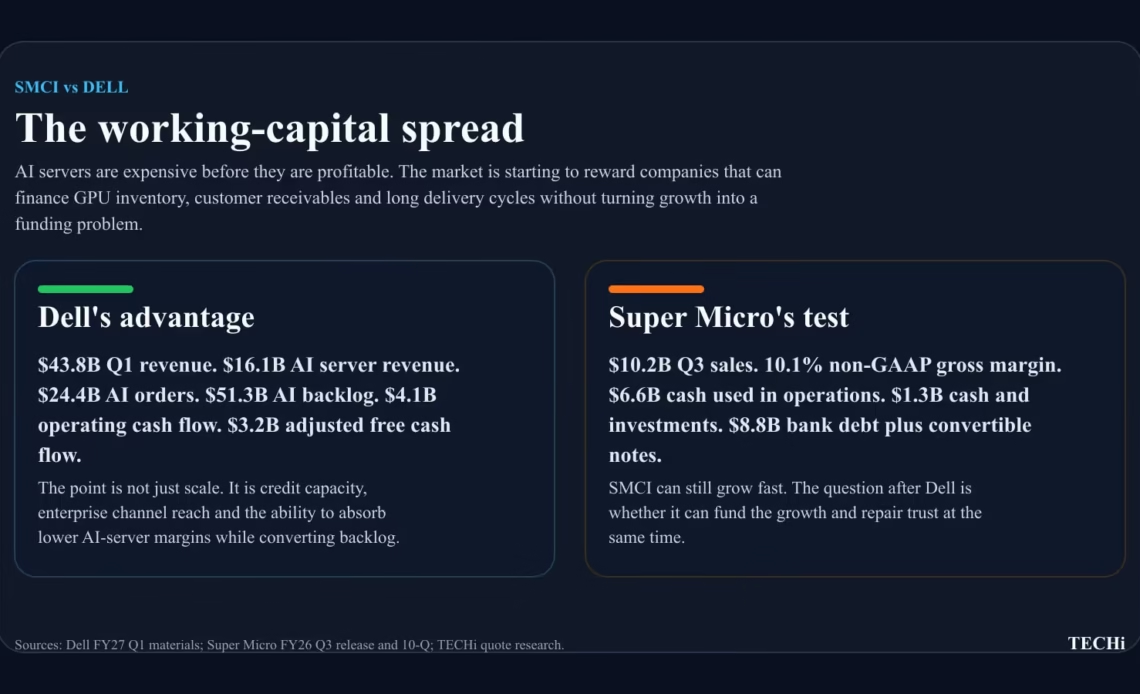
- The harder comparisonDell reported $24.4B of AI server orders, $51.3B of AI backlog and $3.2B of adjusted free cash flow in Q1 FY27. Super Micro reported strong Q3 sales but used $6.6B of cash from operations and carried a weaker controls story.
- The one-year setupSMCI can still work if revenue targets convert cleanly, margins stabilize and control weaknesses are remediated. Without that, Dell’s scale becomes a ceiling on SMCI’s multiple.
Dell changed the question investors should ask
The headline number from Dell was not just revenue. Dell reported $43.8 billion of Q1 FY27 revenue, up 88% year over year, with Infrastructure Solutions Group revenue of $34.1 billion. AI-optimized server revenue was $16.1 billion, and the company said AI server orders reached $24.4 billion. In the company’s performance deck, ending AI backlog was $51.3 billion. Dell also generated $4.1 billion of operating cash flow and $3.2 billion of adjusted free cash flow in the quarter.
Those figures do two things at once. They confirm that AI server demand is real, and they make the business look far more capital intensive than a simple “servers are hot” narrative suggests. Dell can take that demand into a global enterprise channel, finance large customers through its broader balance sheet, source components at scale and absorb lower AI-server profitability while it waits for attach, services, storage and repeat orders.
That is the problem for the SMCI sympathy rally. The more Dell proves the AI server market is huge, the more the market may ask why Super Micro deserves a similar enthusiasm multiple without the same financing depth, procurement leverage or enterprise trust layer. Demand helps everyone. The funding cost of that demand does not.
Super Micro has demand. Its problem is the cost of carrying it
Super Micro is not a broken demand story. Its fiscal Q3 2026 release showed $10.2 billion of net sales, more than double the year-ago period, and management guided Q4 revenue to $11.0 billion to $12.5 billion. Full-year fiscal 2026 guidance sits at $38.9 billion to $40.4 billion. That is serious scale for a company that built its reputation on speed, customization and fast time-to-rack delivery.
The tension is below the revenue line. Q3 non-GAAP gross margin was 10.1%. Operating cash flow was negative $6.6 billion in the quarter. The company ended March 31, 2026 with $1.3 billion of cash, cash equivalents and short-term investments, while bank debt and convertible notes totaled about $8.8 billion. That does not mean SMCI is out of options. It does mean the AI server boom is consuming working capital faster than a clean headline-sales story implies.
This is the piece most quick Dell read-throughs miss. If AI server growth requires enormous GPU prepayments, inventory commitments and receivables support, then the market will not price every server seller equally. It will price the balance sheet, customer trust and cash-conversion cycle. Dell just put those inputs on the front page.

The trust discount is not a footnote
Super Micro also enters this comparison with a governance and controls issue Dell does not have to explain in the same way. In its March 31, 2026 quarterly filing, Super Micro disclosed that internal control over financial reporting was not effective because of material weaknesses, and that previously reported weaknesses remained unremediated as of the quarter end. The filing also notes that the company was unable to timely file its fiscal 2024 Form 10-K and certain quarterly reports in 2024.
That matters more after Dell because enterprise AI buyers are not simply shopping for the lowest server quote. They are choosing partners for multi-quarter deployments where service levels, warranty support, delivery confidence, financing terms and board-level procurement comfort all matter. If Dell can offer the same NVIDIA-driven demand exposure with a cleaner enterprise wrapper, SMCI has to win on more than speed.
The bull response is fair: Super Micro has historically moved faster than larger OEMs, and the company can tailor liquid-cooled AI systems with less bureaucracy. That advantage still counts. But a speed advantage is worth less when customers are ordering entire AI factories rather than one-off server racks. At that scale, trust becomes part of margin.

The margin test after Dell
Dell did not pretend AI servers are high-margin magic. Management has been clear that AI server profitability is structurally lower than other parts of the infrastructure portfolio, with the company targeting a mid-single-digit operating income rate on AI servers over time. The difference is that Dell can surround lower-margin AI server revenue with storage, services, financing and enterprise account control.
That makes SMCI’s margin story more fragile. A 10.1% non-GAAP gross margin leaves little room for component price volatility, delivery delays, customer concentration, warranty cost or liquid-cooling execution problems. If SMCI is using cash to chase revenue at low gross margin while Dell converts backlog with positive free cash flow, investors may eventually stop treating both stocks as the same AI server trade.
What traders should do with the Dell read-through
For traders, the SMCI move makes sense. Dell’s numbers are too large to ignore, and a market trained to buy AI infrastructure leaders will naturally reach for Super Micro when Dell validates server demand. The short-term chart can work if momentum funds keep rotating into AI hardware names. TECHi’s stock universe and mover page is useful here because it shows when the move is a real-time momentum event rather than a stale quote-page echo.
But the better tomorrow advice is not to confuse sympathy with confirmation. If SMCI gaps on Dell euphoria, the first things to watch are volume quality, whether the move holds after the first hour, and whether Dell itself continues to rise once investors digest the gross-margin math. A strong first print that fades would say the market likes AI server demand but is getting more selective about who funds it.
The one-year investor view
For one-year investors, the bar is higher. SMCI needs three things at the same time: revenue delivery against fiscal 2026 guidance, better cash conversion, and a credible path out of the control-weakness discount. Any one of those can move the stock. All three together can change the multiple.
The harder read is that Dell’s quarter may have made SMCI more investable only if Super Micro can prove it is not a lower-quality version of the same trade. If the market concludes that AI servers are now a financing, backlog-conversion and enterprise-trust business, Dell becomes the benchmark, not merely the catalyst.
SMCI rising with Dell is understandable. Dell proving the market is enormous is good for demand. But Dell also made the AI server comparison harsher. Super Micro now has to show it is not only fast. It has to show it is financeable, auditable and margin-resilient at scale. That is the real Dell read-through.
Investment disclaimer: This article is for informational and educational purposes only. It is not financial advice or a recommendation to buy, sell or hold any security. Market prices can move quickly, especially around earnings and premarket trading. Verify current quotes and consult a licensed financial advisor before making investment decisions.