
South Korea exported a record $59.98 billion of information and communications technology products in August, up 162.6% from a year earlier, the Ministry of Science and ICT said on Monday. For the first time, ICT goods made up more than 60% of everything the country sold abroad.
The surplus on that trade was $41.37 billion, also a record and the first time it has passed $40 billion. That is larger than South Korea’s entire trade surplus for the month, which the trade ministry put at $34.75 billion on September 1. Take ICT out, and the rest of the Korean economy ran a trade deficit of about $6.6 billion in August, by TECHi’s calculation.
The numbers arrived on a morning when Korean chip stocks were falling sharply after a weekend of calls from AI industry leaders to slow the technology’s development. They show why investors in Seoul are so sensitive to that debate: South Korea’s export growth has become, in effect, a single bet on global spending on AI data centers.
Article Brief
Key Takeaways
5 Points30s Read
- RecordSouth Korea’s ICT exports hit a record $59.98 billion in August, up 162.6%, and made up more than 60% of total exports for the first time, the Ministry of Science and ICT said.
- ChipsSemiconductor exports rose 209% to about $46.7 billion, or 47.5% of all Korean exports, according to the trade ministry.
- The deficitThe ICT surplus of $41.37 billion was larger than Korea’s total trade surplus of $34.75 billion, leaving about a $6.6 billion deficit on everything else, by TECHi’s calculation.
- The growthICT accounted for about 93% of the roughly $40 billion rise in August exports, and chips alone about 79%, while non-ICT exports grew about 8%.
- The riskThe data landed as Korean chip stocks fell after AI leaders called for slowing AI development, a debate Korea’s export boom is unusually exposed to.
South Korea ICT exports: a record $59.98 billion in August
According to the ministry’s data, as reported by Yonhap, the August figures broke down as follows:
- Total ICT exports: $59.98 billion, up 162.6% from $22.84 billion a year earlier
- Semiconductors: $46.67 billion, up 209%, on demand tied to AI infrastructure spending by global technology companies
- Computers and communications equipment: $6.4 billion, up 383.1%
- Mobile phones: $1.64 billion, up 23.2%
- Display panels: $1.69 billion, down 7%
- ICT imports: $18.61 billion, up 48.8%
- ICT trade surplus: $41.37 billion
Chips alone were about 78% of ICT exports. Computers and communications equipment, a category that includes storage devices such as solid-state drives, grew faster than anything else on the list.
Semiconductor exports: 47.5% of everything Korea sold abroad
The trade ministry’s broader figures, released on September 1, show how far the economy has tilted toward one product. South Korea’s total exports rose 68.7% to $98.25 billion in August, and semiconductor exports were 47.5% of that total, according to the Ministry of Trade, Industry and Resources, as reported by The Korea Times. The trade ministry put chip exports at $46.65 billion, a slightly different figure from the ICT ministry’s $46.67 billion.
Semiconductor exports have now topped $40 billion for three straight months. Imports rose a more modest 22.6% to $63.51 billion, which is how the overall surplus reached $34.75 billion.
Without ICT, South Korea ran a $6.6 billion trade deficit
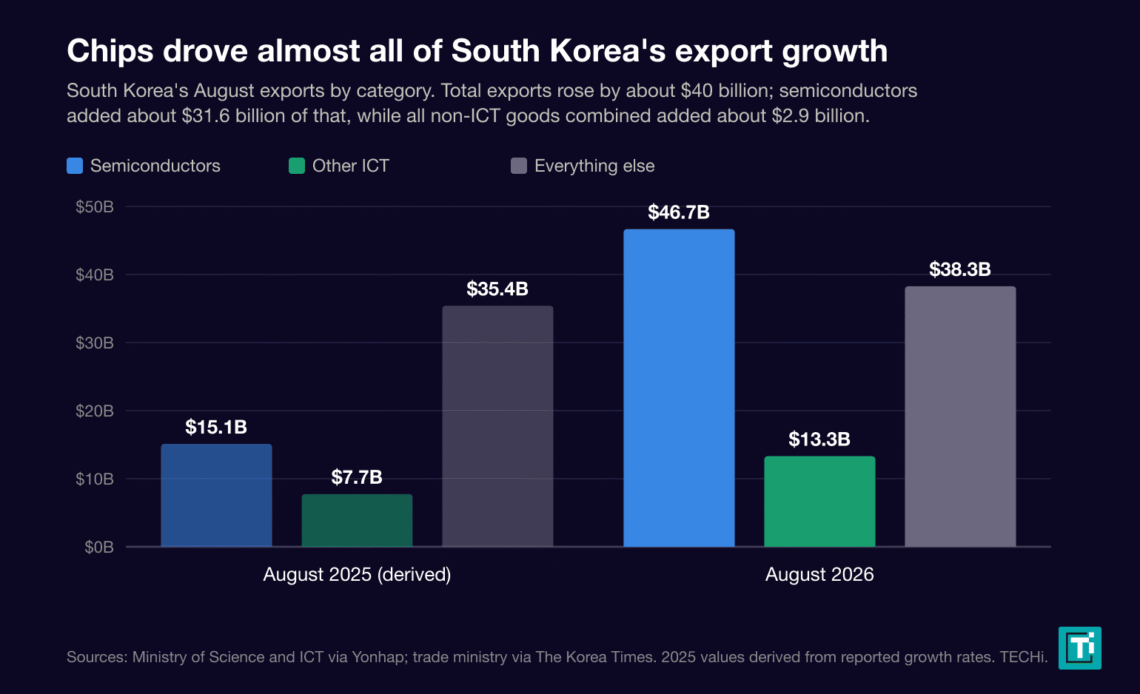
The two ministries’ figures, taken together, give a clearer picture of what is driving Korea’s trade than either release does on its own. TECHi’s calculations from the published numbers:
- Non-ICT exports: about $38.3 billion in August ($98.25 billion total minus $59.98 billion ICT)
- Non-ICT imports: about $44.9 billion ($63.51 billion total minus $18.61 billion ICT)
- Non-ICT trade balance: a deficit of about $6.6 billion
- Growth in non-ICT exports: about 8% from a year earlier, against 162.6% for ICT
- Share of export growth from ICT: about 93% of the roughly $40 billion increase in total exports
- Share of export growth from chips alone: about 79%
The year-earlier comparisons are derived from the growth rates each ministry reported, so they are estimates rather than published totals. But the direction is not in doubt. Everything outside ICT, combined, grew by about 8%. Nearly all of the increase in the country’s exports came from the chips and computer equipment going into AI data centers.

South Korea is on pace for $1 trillion in exports
The August surge is part of a year that has already broken records. South Korea’s cumulative exports reached $709.4 billion by September 5, passing the full-year 2025 total of $709.3 billion 117 days earlier than last year, Seoul Economic Daily reported, citing customs data.
Chips were the reason. From January through August, semiconductor exports rose 169.6% to $281.2 billion, or 40.6% of all exports, and accounted for about 74% of the growth in total exports, the paper reported. “If the current pace continues, we can reach $1 trillion in annual exports in early December, becoming the fourth country to do so after the United States, China and Germany,” said Korea Customs Service Commissioner Lee Jong-wook.
September has started even faster. Exports for the first 10 days of the month rose about 83% to a record $35 billion, with semiconductors up 270% to $16.5 billion, The Korea Herald reported last week. That puts chips at about 47% of exports in those 10 days, in line with August’s 47.5%.
The concentration is also showing up at home. Seoul Economic Daily reported last week that the chip-driven export boom has so far failed to lift jobs and consumer spending in South Korea. When one industry supplies nearly half of a country’s exports, the rest of the economy’s growth depends on how long that industry’s customers keep buying.
Where Korea’s AI chips are going
By destination, the ICT ministry said combined shipments to China and Hong Kong rose 227.9% and exports to the United States rose 306.5%. Shipments to Vietnam increased 81.4%, to the European Union 49.1% and to India 126.7%.
The trade ministry’s total-export figures point the same way. Exports of all goods to China reached $24.1 billion, up 119.3%, and to the United States $16.5 billion, up 89.3%, according to The Korea Times. Some of the memory shipped to China, Hong Kong and Vietnam is assembled into servers and devices that are ultimately sold elsewhere, so the destination data shows supply chains as much as final customers.
Memory prices are doing part of the work
The one weak category in the release is revealing. Display exports fell 7% because panel makers faced pressure to cut costs “due to a rise in memory prices,” Yonhap reported.
Higher memory prices lift the value of Korea’s chip exports even when the number of chips shipped grows more slowly. U.S. server makers are seeing the same effect from the other side: Hewlett Packard Enterprise said in its latest quarterly report that its server revenue growth came “predominantly” from higher average selling prices driven by memory and SSD costs, as TECHi reported in its analysis of HPE’s $30.4 billion in supplier commitments.
That cuts both ways for South Korea. When AI demand is strong, rising prices and rising volumes compound. If AI data-center spending slows, both could fall together.
Why Seoul’s chip stocks fell on the same morning
The ICT data was published during a sharp decline in Korean chip shares. SK hynix fell about 6% and the KOSPI more than 3% in Monday morning trading, as TECHi reported from the Seoul open, after Anthropic chief executive Dario Amodei called for slowing AI progress, including possible limits on “training compute,” and OpenAI’s Sam Altman agreed.
Record exports and falling share prices are not a contradiction. The export figures describe demand that has already been ordered and shipped. The stock prices reflect what investors expect orders to look like next year. An economy where chips are 47.5% of exports, and where almost all export growth comes from one kind of customer, is exactly the kind of economy that reprices fastest when that customer’s leaders start talking about slowing down.
Seoul Economic Daily also attributed the weakness in chip stocks to rising U.S. interest rates and tension in the Middle East, both of which weighed on markets across Asia.
Why Korea’s trade data matters for AI investors everywhere
For investors in Nvidia, Microsoft, Oracle or the server makers, South Korea’s customs figures are one of the fastest hard measures of AI hardware demand available. Korea publishes export data for the first 10 and 20 days of each month, and a full-month report on the first day of the next. Companies report quarterly, weeks after the quarter ends.
That makes the next few releases a real-time test of the weekend’s debate. AI executives have endorsed slowing how quickly models improve, but no company has announced lower spending on chips or data centers. If those commitments are being kept, Korean memory exports should stay near their record pace through September. If buyers start to hesitate, it is likely to show up in Seoul’s trade data before it appears in anyone’s earnings report.
What to watch for South Korea’s chip exports
Mid-September trade data. The customs service’s figures for the first 20 days of September, due around September 21, will show whether the 270% jump in chip exports from the first 10 days is holding.
September full-month exports. The trade ministry publishes September figures on October 1. A fourth straight month above $40 billion in chip exports would confirm that AI orders have not yet responded to the pacing debate.
Samsung’s preliminary third-quarter results. Samsung Electronics typically reports preliminary quarterly figures in early October, the first company-level read on July-to-September memory demand.
AI companies’ spending plans. Korea’s export boom depends on hyperscalers and AI labs continuing to build the kind of facilities TECHi priced in its data center cost guide. Any company that actually cuts a capital budget or a compute contract would matter more to Korean exports than any essay.
The Federal Reserve on Wednesday. Higher U.S. rates raise the cost of financing the data centers that buy Korean memory.