
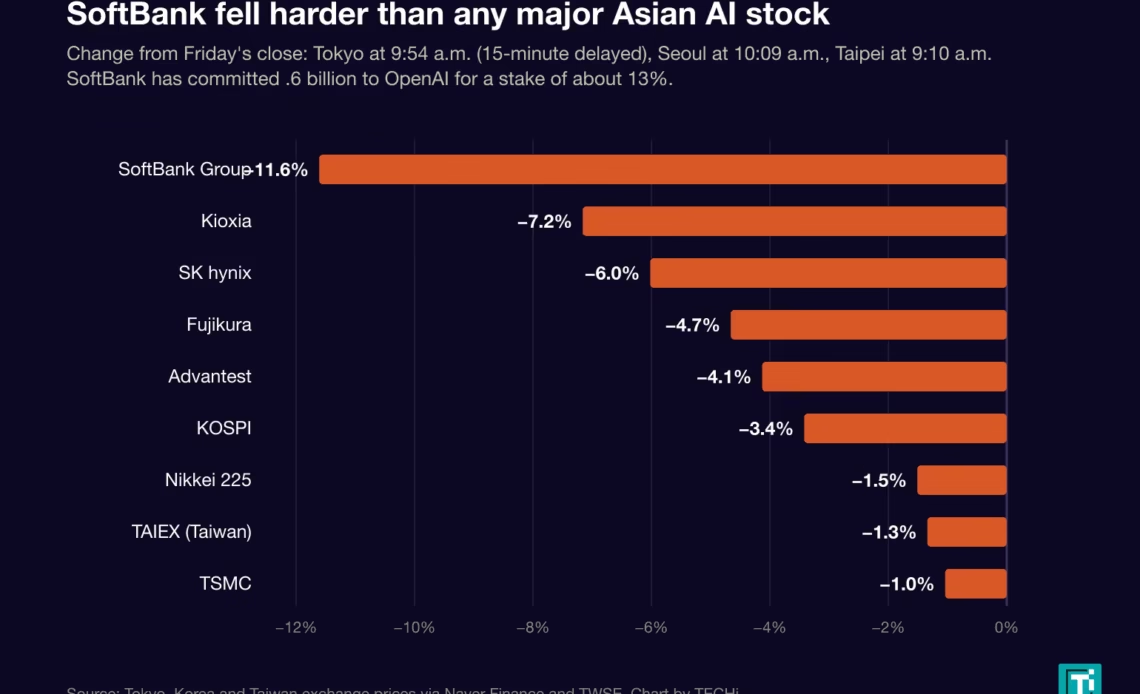
SoftBank Group shares fell nearly 12% in Tokyo on Monday, the steepest drop among the major Asian AI stocks TECHi tracked, as investors got their first chance to trade the weekend’s calls from AI industry leaders to slow the development of the technology. SoftBank has committed $64.6 billion to OpenAI, whose chief executive backed that call.
The stock could not trade for the first 19 minutes of the session. When it did, at 9:19 a.m. Tokyo time, it opened at 5,926 yen, down 9.4% from Friday’s close of 6,540 yen. By 9:54 a.m. it had fallen as low as 5,720 yen and was trading at 5,781 yen, down 11.6%.
SoftBank’s fall was more than eleven times Taiwan Semiconductor Manufacturing’s 1.0% decline in Taipei and about twice SK hynix’s 6.0% drop in Seoul. The size of that gap says the market is not just selling AI hardware. It is repricing the companies whose value rests on how quickly frontier AI labs grow.
Article Brief
Key Takeaways
5 Points30s Read
- The dropSoftBank Group shares did not trade for 19 minutes, opened down 9.4% and were down 11.6% at 5,781 yen by 9:54 a.m. in Tokyo, after touching 5,720 yen.
- The OpenAI linkSoftBank has committed $64.6 billion to OpenAI for about 13%, and OpenAI’s Sam Altman backed Anthropic CEO Dario Amodei’s call to pace AI development.
- No IPO this yearAltman called now “an ill-advised moment to go public,” while SoftBank’s newest OpenAI shares are preferred shares that convert to common stock at an IPO.
- The financingSoftBank repays the remaining $25.9 billion of its OpenAI bridge loan on Tuesday, has a $10 billion margin loan backed by the stake, and its last $10 billion tranche is due Oct. 1.
- The spreadSoftBank fell more than 11 times as much as TSMC (down 1.0%) and about twice as much as SK hynix (down 6.0%).
SoftBank stock falls 11.6%: how Monday’s session unfolded
Tokyo’s data is published with a 15-minute delay. Based on one-minute trading data and the exchange feed published by Naver Finance:
- Friday’s close: 6,540 yen, itself down 4.0% on the day
- No trades from 9:00 to 9:19 a.m.: the stock did not trade in the opening minutes
- First trade at 9:19 a.m.: 5,926 yen, down 9.4%, with about 1.5 million shares changing hands in the first minute
- Session low by 9:54 a.m.: 5,720 yen, down 12.5%
- Price at 9:54 a.m.: 5,781 yen, down 11.6%
Trading was heavy once it began. About 18.7 million shares had changed hands by 9:57 a.m., roughly 36% of the 51.9 million shares SoftBank has averaged per full session over the past three months, a TECHi calculation from exchange volume data.
On the Tokyo Stock Exchange, a stock with far more sell orders than buy orders at the open can go several minutes without a first trade while the exchange shows indicative prices. SoftBank’s delayed open was consistent with that kind of imbalance.
If the loss holds to the close, it would rank among SoftBank’s worst days of the past two years, alongside a 12.5% drop on June 26, 2026, and a 12.3% fall on April 7, 2025, according to TECHi’s review of daily closing prices. The shares are now about 36% below their 52-week high of 9,074 yen, though still well above where they started the year.

Why OpenAI’s slowdown talk hits SoftBank hardest
SoftBank’s exposure to OpenAI is large and specific. In a February 27 announcement, the company said it had agreed to invest a further $30 billion in OpenAI at a pre-money valuation of $730 billion. Once complete, that brings its cumulative investment to $64.6 billion, for an ownership stake of about 13%.
Over the weekend, OpenAI chief executive Sam Altman publicly agreed with Anthropic chief executive Dario Amodei’s essay calling for the industry to slow the pace at which AI models improve. “I agree with Dario that we need to pace the frontier,” Altman wrote, according to TechCrunch. “This has been a primary topic of discussions we’ve had at OpenAI in recent weeks.”
For most chip stocks, a slowdown threatens future orders. For SoftBank, it touches the value of one of its largest bets. OpenAI’s valuation depends on how fast it can keep improving its models and turning them into revenue, and its own chief executive has now said the company should pace that improvement.
What the AI pacing plan would mean for OpenAI
Amodei’s essay, “We Must Pace the Frontier,” set out three steps. First, each frontier AI company would give outside evaluators, such as the research group METR, “ongoing, employee-like access” to verify its safety practices and report incidents. Second, AI companies in democratic countries would coordinate on common safety standards “as well as limits on the rate of unchecked AI progress.” Third, democratic governments would attempt coordination with authoritarian ones where compliance can be verified.
Anthropic said it is adopting the first step on its own, and TechCrunch reported that Altman indicated OpenAI will follow. Amodei wrote that pacing “does not mean halting model training or technical progress,” but also that companies “should also consider pacing based on limiting the ingredients that go into frontier models, such as training compute.”
For an investor in OpenAI, the question is how much slower growth that implies. None of the companies has put a number on it, which leaves the market to price the uncertainty. On Monday morning in Tokyo, investors weighed that uncertainty alongside oil prices above $100 a barrel and an expected U.S. rate hike, and SoftBank’s share price fell about 12%. Those other two pressures hit every Asian market, but only the stocks most tied to AI growth fell by 6% or more.
The second weekend comment matters even more to SoftBank. “I actually think that given everything happening with safety, right now would be an ill-advised moment to go public,” Altman said in a Fortune interview published on Saturday, TechCrunch reported.
According to SoftBank’s February announcement, the securities it received in the follow-on round are preferred shares that convert to common shares upon an initial public offering or a related listing. An OpenAI IPO is the most direct route for SoftBank to hold listed, tradable OpenAI stock. Altman’s comments push that event beyond 2026, which leaves SoftBank holding a private, harder-to-value stake for longer.
Rival Anthropic is moving the other way. It has reportedly chosen Nasdaq for a potential listing, and the Financial Times reported late Sunday that Anthropic expects a second profitable quarter as its IPO nears.
SoftBank’s OpenAI financing: $25.9 billion due Tuesday, $10 billion on October 1
The timing is also awkward for SoftBank’s balance sheet. SoftBank will repay the remaining $25.9 billion of a $40 billion bridge loan used to finance its OpenAI investment on Tuesday, September 15, according to a Bloomberg report published by Yahoo Finance. The unsecured loan was not due until March 2027.
Bloomberg reported that SoftBank is refinancing with longer-term debt, including a possible junk-bond sale of $10 billion to $20 billion and a $10 billion margin loan backed by its OpenAI stake. Bloomberg Intelligence analyst Kirk Boodry was quoted as saying, “With markets concerned about leverage in general, better to get it done early and avoid any drama.”
The February announcement also set out how the $30 billion follow-on would be paid: three $10 billion tranches on April 1, July 1 and October 1, 2026. On that schedule, SoftBank’s final $10 billion payment to OpenAI is due in just over two weeks, a TECHi reading of the published terms.
That leaves SoftBank borrowing against an OpenAI stake at the same moment OpenAI’s chief executive has ruled out a listing this year and backed slowing the pace of frontier AI.
Kioxia, SK hynix and TSMC: how the rest of Asia’s AI trade moved
SoftBank led a broad selloff in Asian technology stocks, but the size of each move tracked how directly a company depends on the growth of AI training. Prices around 10 a.m. local time:
- Kioxia, the Japanese memory maker: down 7.2% at 50,160 yen, after also not trading in the opening minutes
- SK hynix, the Korean supplier of high-bandwidth memory for AI chips: down 6.0% at 1,703,000 won
- Fujikura, a fiber-optic cable supplier to data centers: down 4.7%
- Advantest, which makes chip-testing equipment: down 4.1%
- KOSPI: down 3.4%
- Nikkei 225: down 1.5%
- Taiwan’s TAIEX: down 1.3%
- TSMC: down 1.0% at 2,385 Taiwan dollars
TSMC’s smaller decline is notable because it manufactures most of the world’s advanced AI accelerators. Investors appear to be treating the foundry, which serves many customers and product types, as less exposed than memory makers and financial backers of AI labs. TECHi reported earlier on Monday that SK hynix and the KOSPI fell sharply at the Seoul open, and that U.S. Nasdaq 100 futures had fallen about twice as much as S&P 500 futures on Sunday evening.
What to watch for SoftBank this week
Tuesday’s loan repayment. Confirmation that the $25.9 billion repayment has been completed, and the terms of any bond sale that follows, will show how easily SoftBank can fund its OpenAI commitments.
Whether the October 1 payment changes. Any revision to the final $10 billion tranche would be a significant signal about SoftBank’s appetite for more OpenAI exposure at current terms.
OpenAI’s response to the pacing debate. Details on how OpenAI plans to implement Altman’s support for pacing, including the embedded outside evaluators Amodei proposed, will shape how investors value its growth.
The Fed on Wednesday. Higher U.S. interest rates would raise SoftBank’s borrowing costs as it refinances. The Federal Reserve announces its decision at 2 p.m. Eastern on Wednesday, and prediction market Kalshi priced a quarter-point hike at 77% on Sunday evening.
Tokyo’s close. The Tokyo session ends at 3:30 p.m. local time. Whether SoftBank recovers from its low or closes near it will show whether Monday’s selling was a single opening shock or a lasting reassessment of its OpenAI bet.