
Few smartphone brands have truly championed the value game as much as Poco. It’s consistently delivered some of the best budget smartphones around. Take the OG Poco F1, for example. Fast forward to 2026, and the tech industry is in a pickle. AI DRAM shortages have hit everyone, and Poco has just come out with a new mid-ranger: the Poco X8. It starts at ₹29,999 in India, and for that, you get the Snapdragon 6s Gen 4 processor, paired with 8GB LPDDR4X RAM and 256GB UFS 3.1 storage. There’s also a 12-bit 120Hz AMOLED display, a 50MP main camera, and a massive 9,000 mAh battery.
This package sounds decent on paper, but is it worth your money? To find out, I’ve been using the Poco X8 daily for the past two weeks as my secondary smartphone. It’s flown with me to events in Delhi, and I’ve also played several games to test its real-world performance.
Poco X8 Review
Summary
I love the PocoX8’s industrial design, the 120Hz 12-bit AMOLED display is genuinely excellent, and the Snapdragon 6s Gen 4 delivers smooth everyday performance without heating up. The real star, though, is the 9,000mAh battery. Cameras are decent, but the 1080p at 30 FPS videos feels restrictive in 2026.
Design & Hardware

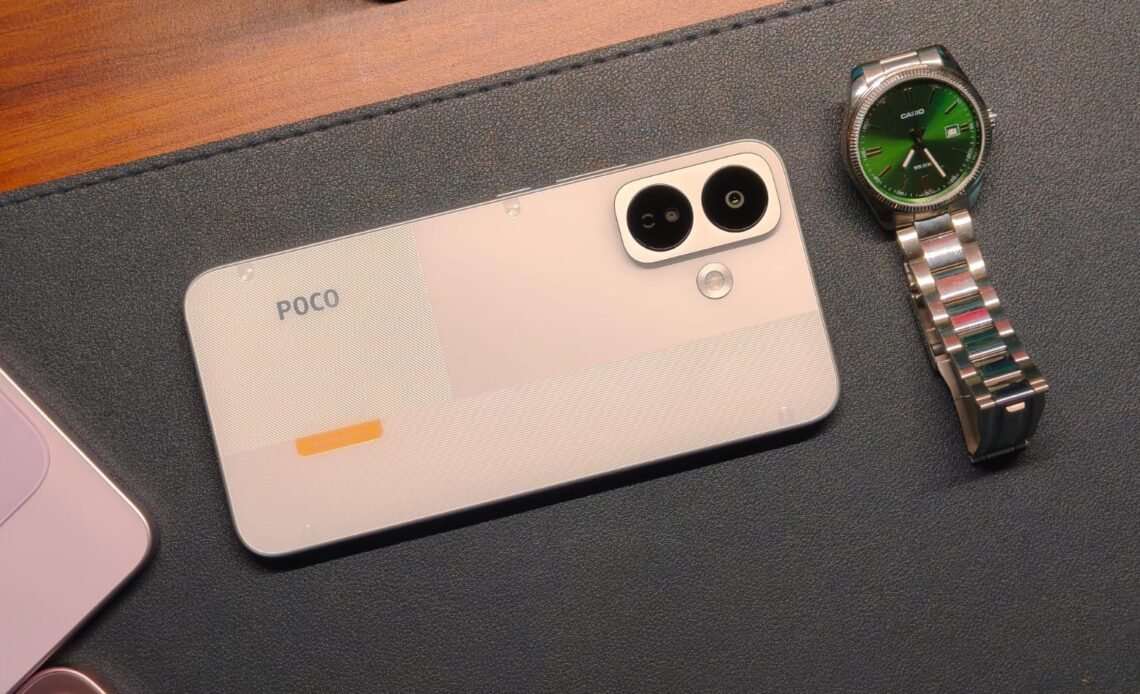
Plenty of budget phones—and even some mid-rangers—fall into the trap of trying to look expensive. While this decision sometimes pays off, usually the phone just ends up looking rather inexpensive, just with a beautiful wrapper. Thankfully, Poco hasn’t done that. I love the fact that the Poco X8 leans into the industrial look without overdoing it. The back finish is divided into three sections. The right side has vertical lines, the bottom-left section has a textured, Velcro-like pattern, and the rest uses a smooth finish. You don’t feel any of these textures because there’s a plastic back on top. Still, it’s a design that shouldn’t have worked, but it does.
My white review unit got plenty of questions from my friends and family, each asking what phone it was. They also complimented the phone’s design. Moving on to the camera module, it’s a rectangular island on the top left, with a flash module on the side. It’s simple and elegant. The sides are made of plastic, which wasn’t much of a concern. They’ve held up surprisingly well during my no-case testing. I didn’t think the flat sides would be that comfortable, but they were. My thumb can reach roughly 60% of the display, which is okay. People with tiny hands might have a little trouble.
With the X8, you also get a slew of water and dust resistance ratings, including IP66, IP68, IP69, and IP69K. In simple terms, you can take your X8 swimming in a pool and take pictures underwater. The front houses an optical fingerprint sensor. It isn’t the fastest, but it did the job well with my greasy fingers.
Display

A mid-range phone often means compromises, but Poco has somehow avoided that altogether, at least in the display. That’s because it features a 6.83-inch 1.5K AMOLED panel with a 120Hz refresh rate. That sounds pretty standard, right? But Poco has added a 12-bit panel, something not many flagship phones even offer. This translates into excellent color reproduction when watching movies, helped even more by 100% coverage of the DCI-P3 color space. Beyond that, the X8’s display is HDR10+ and Dolby Vision certified, and its 3,500-nit peak brightness makes HDR content genuinely pop.
While I don’t have a light meter to measure the actual brightness, I took the Poco X8 out on a hot Indian summer day. The panel was clearly visible in the midday sun, and I could read small text without any squinting. Colors don’t shift when viewed at an angle. It also has Wet Touch 2.0, which is supposed to help with wet fingers. As for durability, the X8’s display is protected by the Corning Gorilla Glass Victus 2. While I didn’t intentionally throw the phone, it slipped out of my pocket once and fell from hip height. Despite it landing face-first, there was no major damage, and Poco pre-applies a screen protector.
Performance & Software

If you’ve followed Poco’s journey, then you know performance is its main selling point. And while the AI price increase has put a thorn in that journey, the X8 is still undercutting the competition. Inside, you get the Snapdragon 6s Gen 4 processor, along with up to 8GB DDR4 RAM and 256GB UFS 3.1 storage. The UI is Xiaomi’s HyperOS, which is one of the more stable Android skins.
I found the Poco X8 to be quite competent for everyday work. Whether it was doomscrolling Reels, booking metro tickets, or navigating with Google Maps, the X8 felt consistently smooth. The phone didn’t stutter, and the refresh rate didn’t drop in certain apps. Animations, while not being flagship-level, were much smoother than the Redmi Note 17 I tested a few months back. Beyond that, you get a slew of HyperOS features. I love the lock screen customization, which makes the phone more personal. You can also choose between different themes. Sadly, even though I opted out, the phone still came with plenty of pre-installed apps and games. It’s not a major problem, since Poco lets you uninstall them all, but it’s still an annoyance. On the bright side, Poco has promised four years of major Android updates.
Since this is a review, I also put the Snapdragon 6s Gen 4 through its paces with a series of benchmarks. In Geekbench 7, the phone scored 856 in the single-core test and 2,345 in the multi-core test. In AnTuTu, it reached 787,543 points. The phone also maintained its performance under sustained heavy workloads, without heating up. As for gaming, I played BGMI on the Poco X8. The experience? Pretty respectable gameplay on the Smooth + Extreme graphics setting. The frame rates never really dropped below 60 FPS, even during intense combat, and there was no thermal throttling after an hour-long session.
Battery & Charging

The Poco X8 makes the strongest case for itself in terms of battery life. With a 9,000 mAh silicon-carbon cell, it’s an unkillable phone. Whether I shot videos all day, clicked photos, or played BGMI for hours, I still had some battery left at the end of the day. With light usage, you can easily go multiple days—I’d say around three—on a single charge.
Charging is handled by a 67W adapter (included in the box), and I’ve nothing to complain about it. It recharged my X8 from zero to full in just over an hour. You can also use the Poco X8 to reverse-charge other phones at 27W.
Cameras

The Poco X8 has a dual-ish camera setup. I say “ish” because you get a pretty competent 50MP main sensor with an f/1.8 aperture and OIS support. But the phone pairs that with a 2MP depth sensor. Given the hardware, I wasn’t that excited to test these cameras, but are they bad? Actually not. Poco has done a decent job optimizing the image-processing pipelines because the main sensor takes good photos. In ample light, it delivered good sharpness, along with great colors and good HDR performance. It sometimes blows out highlights in direct sunlight. Even the daytime portraits looked pretty nice. Sure, the details are a little less apparent because the phone crops in the main sensor, but you can still throw these photos on Instagram without any hesitation.
Things go south when you shoot in the dark. Don’t get me wrong, the photos in artificial lighting aren’t bad. There’s detail, and the shadows aren’t gone. However, I did see noise creeping in from the sides, and the colors looked a bit washed out. Fortunately, Xiaomi does bundle a few filters, using which I could boost the colors for photos that looked quite good.
Videos are capped at just 1080p 30 FPS, which isn’t much to brag about in 2026. The selfie shooter, on the other hand, is pretty good, delivering sharp photos without much beautification.
Verdict

Starting at ₹29,990, the Poco X8 is certainly the product of 2026’s price increases. But despite that, I think it’s a good device. I love the industrial design, the 120Hz 12-bit AMOLED display is genuinely excellent, and the Snapdragon 6s Gen 4 delivers smooth everyday performance without heating up. The real star, though, is the 9,000mAh battery. It’s easily one of the longest-lasting phones I’ve tested, and going two days without worrying about a charger feels refreshing.
The compromises are predictable. Low-light photos are okay rather than impressive, video recording is limited to 1080p at 30 FPS, and HyperOS still ships with more bloatware than I’d like. Still, if you’re after the best battery life and display in this price range, the Poco X8 is an easy recommendation.