
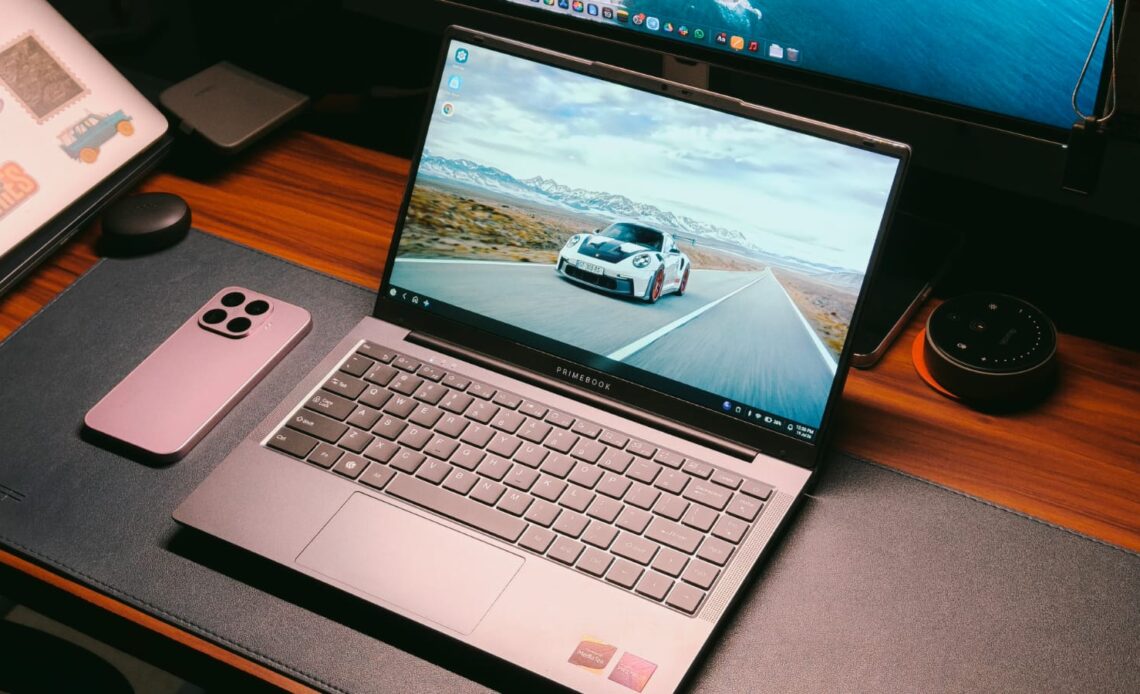
We’re halfway through 2026, and if there’s one thing we’ve all noticed this year, it’s rising tech prices. Everything is more expensive than last year, all thanks to AI, which has scooped up all memory production, driving prices to insane levels. This has almost killed the budget smartphone space, and the same is happening to laptops. Even Apple raised MacBook prices by well over ₹1 lakh in some configurations. Imagine this: you’re a student or a parent, and you need a budget-friendly laptop to complete schoolwork. Maybe it’s completing a project, or studying for the next exam on a bigger screen; you get the point.
That’s exactly the problem PrimeBook aims to solve. For the uninitiated, it’s an Indian startup that focuses on making Android laptops, similar to Chromebooks, that help you write documents, study using online tools like YouTube, and don’t cost a bank. One example is the PrimeBook 2 Pro, which features a 14-inch full HD display and runs on the Helio G99 processor. Since you get all that for ₹26,999, I knew I had to test it. I’ve been using the Primebook 2 Pro for the better part of two weeks, and this review should help you decide whether it’s worth it.
Primebook 2 Pro Review
Summary
The Primebook 2 Pro is a unique machine. The design is way more premium than I expected. The keyboard is great to type on, and even the performance is serviceable. Where Primebook still needs to work on is the optimization. People shouldn’t need to request apps they want to install. Still, it’s a capable studying machine
Design & Hardware

It’s very hard to judge a laptop’s design on such tight budgets because, you know, brands simply don’t have the budget for extensive R&D. While this is what I’ve thought about many of the budget laptops I’ve tested, the PrimeBook 2 Pro is actually designed rather well. Don’t get me wrong, you won’t get the premium metal design, but for the price, the plastic build is excellent. The silver color mimics aluminum, which I quite like, and I observed no flex in the chassis, no matter the pressure. The top has a matte finish that looks sophisticated and doesn’t pick up any fingerprints. I could use the laptop in a trendy cafe without looking out of place.
Open the laptop, and you’re greeted by the same premium feel, except this time the keyboard deck has a MacBook-esque finish. The lid extends slightly below the chassis, making it easier to open. The hinge, however, isn’t much to write home about. It keeps the screen steady, but I found it to be quite stiff. I always had to use two hands to open the laptop, which is a nitpick. Still, the best part about the PrimeBook 2 Pro is the portability. The 14-inch form factor was perfect for slipping into any backpack, and the 1.38 kg weight was light enough to carry the laptop anywhere.
As far as ports are concerned, Primebook hasn’t taken the MacBook route. That’s because you get dual USB-A ports for connecting accessories, a USB-C port for charging, a microSD slot, and a 3.5mm headphone/microphone combo jack. While I couldn’t find the speeds for the mentioned ports, it’s hard to complain much at this price.
Keyboard & Trackpad

When making a budget laptop, the keyboard is usually first on the chopping board to cut costs. While I agree with this sentiment, the keyboard is one of the main ways to interact with the laptop, and I’m glad Primebook 2 Pro doesn’t follow the norm. Its keyboard is perfectly fine. There are no highlight features, but, most importantly, no glaring issues. I got used to the layout pretty quickly. The feedback, while not as tactile as my MacBook, was good enough for long typing sessions. There’s an extra row of shortcuts to get home, end task, and scroll the page, all of which were useful during my testing.
Where things went south was with the trackpad. First up, its sensitivity is way too high. A small flick raced the pointer from one end to the other when all I was trying to do was click the publish button on an article. The second issue is the gestures. Remember the extra row on the keyboard for page-up and page-down. Yeah, you’d be using that quite a lot since scrolling with two fingers moves the page by just an inch. I tried finding settings to adjust both of these things, but I couldn’t. So keep that in mind.
Display & Camera

The PrimeBook 2 Pro features a 14-inch FHD IPS display with a 60Hz refresh rate. For the price, it’s pretty serviceable. The text was easy to read, even the smaller fine print. The colors were decent, making it a good experience to watch YouTube. Even the viewing angles were quite good. There was some color shifting when viewed from an angle, but not as much as with TN panels. The anti-reflective coating also did its job well, keeping background reflection at bay. The only complaint regarding the display would be the brightness. It’s not enough to overcome the light on a sunny day inside a brightly lit cafe.
The best way I can describe the alleged 1440p webcam is that you can use it for video calls. Don’t expect it to represent how your face actually looks or to have any sharpness, and you’d be good to go.
Performance & Battery

Inside the Primebook 2 Pro is the MediaTek Helio G99 processor, which, I agree, isn’t the newest kid on the block. It’s paired with 8GB of LPDDR4X RAM and an unnamed 128GB UFS storage. PrimeOS runs smoothly on the hardware. I could open and close applications reasonably quickly without waiting long. Most of my work happens in Chrome, so I used the laptop for a bit of news writing, along with my usual suite of research tabs. It kept over 10 tabs in memory without stuttering, so I believe studying with the 2 Pro should work out fine.
Where I did notice the 4-year-old processor was when running YouTube. The UI loaded quickly and fine, but when I clicked to play a video, there was a brief hitch before it actually played. This was the case with every video I tried playing. The issue became even more noticeable when I opened WhatsApp Web, which I believe many students would. The laptop took a long while loading my messages, and navigating between the different message tabs was a less-than-ideal experience.
The PrimeBook 2 Pro is powered by a 60Wh battery. When coupled with the non-flagship internals, the laptop’s battery life is excellent. When working on Chrome, it lasted me two full days of use, with the screen on time hovering around the 9-hour mark.
PrimeOS

It’s time to talk about PrimeOS. It’s Primebook’s custom Android-based operating system that takes the big-screen Android experience and adds a few desktop-inspired features. It was my first time using PrimeOS, and it’s a decent take. Apps are neatly tucked away into a Finder-like place. The file manager is inspired by both macOS and Windows and does a very good job of organizing files into easily understandable tabs. App support, though, is a bit complicated. Primebook claims you get access to the “entire Android app ecosystem,” but I couldn’t find all the apps. Sure, most of the important apps like PowerPoint, Docs, and others are included, but it’s not a complete list. If you need more apps, you’ll need to request them specifically, which is a bit counterintuitive in my opinion. It’s worth checking that the apps you need are available before buying.
Beyond that, since not everything can run on Android, Primebook offers Cloud PC functionality. It lets users emulate Windows or Linux on their laptop, albeit with a fee. Subscriptions start at ₹99 for Linux and ₹499 for Windows. Sadly, I did not get the opportunity to test the functionality during my review period. There is also PrimeCoding, the brand’s own beginner-friendly coding platform. The implementation is simple but useful for beginners learning the basics of programming. Do I see PrimeOS becoming big in the next few years? Yes.
Verdict

At ₹26,990, the PrimeBook 2 Pro is a unique machine. It’s neither a traditional Windows laptop nor a Chromebook. It’s something in between, and there are a lot of good things about the laptop. The design is way more premium than I expected. The keyboard is great to type on, and even the performance is serviceable. Where Primebook still needs to work on is the optimization. People shouldn’t need to request apps they want to install. Everything that runs on Android should already be there. Still, the Primebook 2 Pro is a capable machine that, if you’re looking for something to study on, will work just fine and serve you for a few years.