
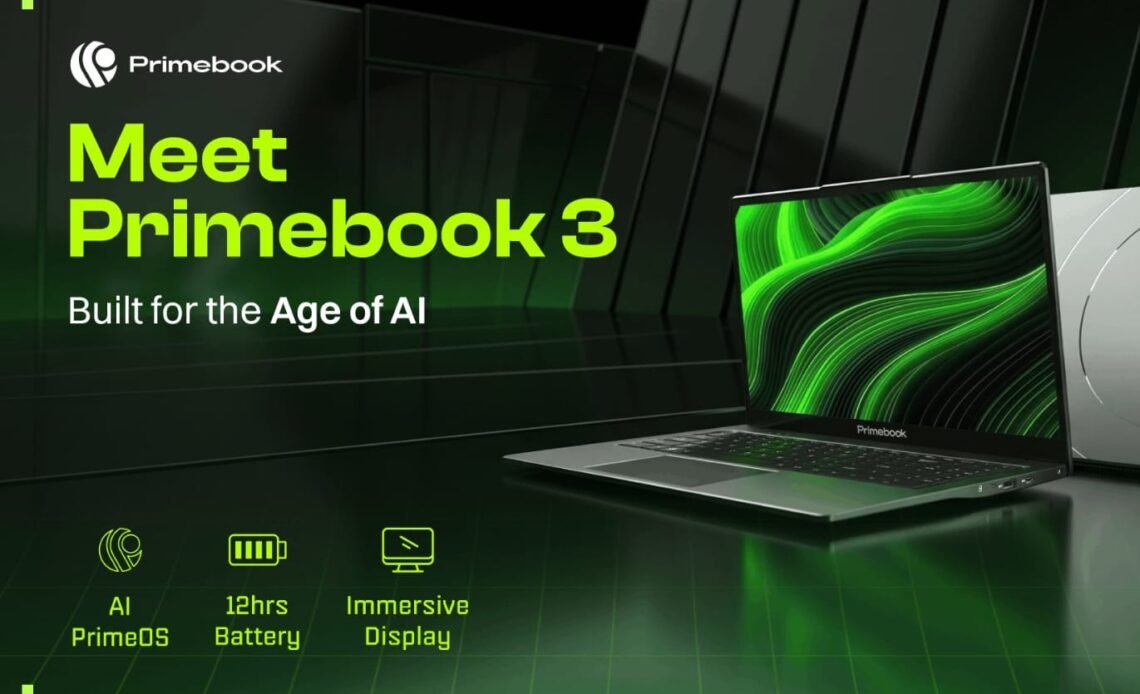
After the success of the Primebook 2 Pro, the company has unveiled its third-generation laptop lineup, led by the new Primebook 3 Max, launching around October 1. The biggest upgrades include a new MediaTek Genio 720 processor with an integrated AI NPU, faster LPDDR5 memory, a metallic design, and a significantly expanded software experience through PrimeOS. Primebook has also confirmed that a Primebook 3 Pro model will join the lineup later.
Primebook 3 Max Gets Upgraded Internals
The biggest hardware change in the Primebook 3 Max is the move to the MediaTek Genio 720 octa-core processor. It features two Cortex-A78 performance cores clocked at 2.6GHz alongside six Cortex-A55 efficiency cores, paired with a Mali-G57 MC2 GPU. More importantly, the chipset includes an integrated Neural Processing Unit (NPU) that enables AI workloads to run directly on the device instead of relying entirely on cloud processing.
Primebook says the new platform delivers up to 40% better performance than the previous generation. The processor is paired with 8GB LPDDR5 RAM, replacing the earlier model’s LPDDR4X memory, while storage starts at 128GB UFS and can be expanded up to 1TB via external storage. The laptop also packs a 60.3Wh battery with support for 36W USB-C fast charging, and the company claims up to 12–14 hours of battery life depending on the model.
The Primebook 3 Max features a 15.6-inch Full HD IPS anti-glare display with a matte finish, while the upcoming Pro variant will also be available in a 14.1-inch configuration. Connectivity has also been upgraded to Wi-Fi 6 and Bluetooth 5.3, along with a full-function USB 3.2 Type-C port that supports charging, display output, OTG, and accessories. Additional ports include USB-A 3.2, USB-A 2.0, another USB-C 2.0 port, a microSD card slot, and a 3.5mm headphone jack. For online classes and meetings, the laptop includes a 5MP webcam that can record 1440p video at 30fps.
Microsoft Office Alternatives & Linux Support

One notable addition is PrimeOffice, Primebook’s productivity suite designed specifically for PrimeOS. Because Microsoft Office has limited functionality on Android-based platforms, Primebook developed its own offline-first alternative: PrimeDocs, PrimeSheets, and PrimePresent. The company claims the suite offers more than 90% of the functionality most users need for documents, spreadsheets, and presentations. Rather than recreating the complexity of traditional desktop office software, PrimeOffice focuses on a cleaner interface, keeping frequently used tools easily accessible.
Beyond Android applications, PrimeOS is expanding its software ecosystem by adding native Linux application support. Because PrimeOS is built on the Linux kernel, users can access a Linux terminal and run several popular desktop development tools without additional virtualization. Supported applications include Visual Studio Code, GIMP, LibreOffice, Firefox, Arduino IDE, DBeaver CE, TablePlus, and Postman. This makes the Primebook 3 Max considerably more appealing to engineering students, aspiring developers, and users who regularly work with coding tools or command-line workflows.
Primebook has confirmed that the Primebook 3 Max will start at ₹35,990 and will be available through Amazon, Flipkart, Primebook’s official website, and selected offline retailers.