
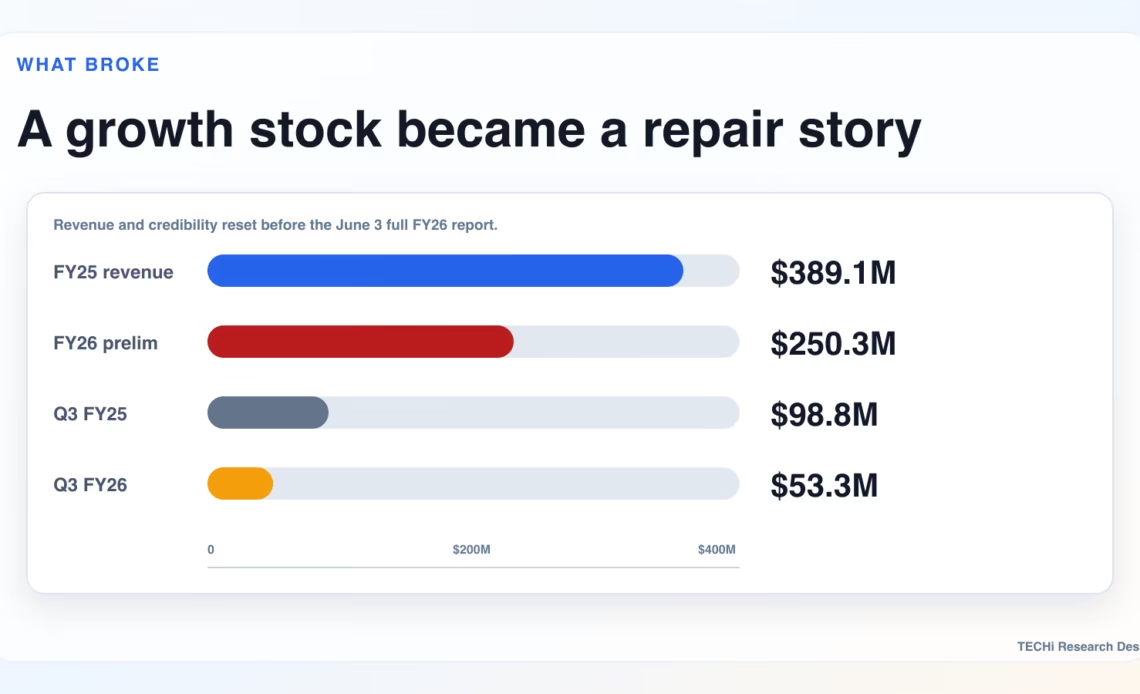
C3.ai reports full fiscal 2026 results on June 3, but the normal earnings-preview frame is almost useless here. The company has already given investors the headline numbers. The real report is whether Thomas Siebel, back in the CEO chair, can make enterprise AI look investable again after a year that turned a growth stock into a repair story.
The market does not need another generic take on artificial intelligence demand. Everyone already knows enterprises want AI. The harder question is whether a standalone enterprise AI application vendor can sell it with real software economics, repeatable go-to-market execution and a cash profile that does not force shareholders to underwrite endless experimentation.
That is the setup for C3.ai. TECHi shows AI at $10.22 after-hours on May 28, up 6.57%, with a 52-week range of $7.68 to $30.24. The TECHi stocks hub gives the ticker a Hold stance with a weak 40/100 one-year signal, while the quote page shows a next-trading-day Hold and only a +0.3% model expectation. The stock is cheap-looking only if the turnaround is real.
Article Brief
Key Takeaways
4 points24s read
- The real reportC3.ai already preannounced Q4 FY26 revenue of $51.6 million and full-year revenue of $250.3 million. June 3 is mostly a credibility call.
- The founder resetThomas Siebel resumed the CEO role on May 8, with Stephen Ehikian continuing as president after two quarters of restructuring work.
- The burn problemFree cash flow was negative $137.4 million through the first nine months of FY26, while preliminary year-end cash and investments stood at $575.4 million.
- The investability testEnterprise AI becomes investable here only if bookings recover, gross margin normalizes and the $135 million cost-savings plan starts showing up in cash flow.
The numbers are not the suspense
C3.ai already preannounced the important scorecard on May 12. In its preliminary fourth-quarter and fiscal 2026 release, the company said Q4 revenue was $51.6 million, within its $48 million to $52 million guide. Full-year revenue was $250.3 million, also inside guidance. On the surface, that sounds acceptable.
It is not acceptable in the context that matters. C3.ai reported $389.1 million of revenue in fiscal 2025. Preliminary fiscal 2026 revenue of $250.3 million means the company lost roughly one-third of its annual revenue base in a year when the rest of the market was rewarding almost anything attached to AI infrastructure, agents or enterprise automation.
The operating loss is even harder to massage. The preliminary release shows a fiscal 2026 GAAP operating loss of $498.5 million and a non-GAAP operating loss of $217.8 million. Management can point to restructuring costs and stock compensation adjustments, but the cash market is not confused. It wants proof that the burn curve has changed.

What broke before Siebel came back
The cleanest evidence is the January quarter. In fiscal Q3 2026 results, revenue fell to $53.3 million from $98.8 million a year earlier. Subscription revenue was down 44%. Total gross margin was 17%, compared with 59% a year earlier. Non-GAAP gross margin was 37%. That is not what public investors expect from a category-defining software business.
C3.ai can argue that the transition year distorted the numbers. That argument has some support. The company reorganized sales and services, reworked leadership, pushed deeper into federal and defense accounts, and launched a restructuring plan expected to reduce annualized non-GAAP operating expenses and cash burn by about $135 million.
But the same facts cut both ways. A software company that needs founder involvement to close enough enterprise deals has a go-to-market risk. Siebel himself said in the Q1 FY26 release that his health issues prevented him from participating in the sales process as actively as he had in the past, and with hindsight, that participation may have mattered more than he previously thought. That is a remarkable admission. It is also the reason his return is material.
The founder headline is also the red flag
Siebel returning is not a normal management shuffle. It is the central valuation variable. He has credibility with large enterprise buyers, a long record in enterprise software and the authority to push through a painful reset without sounding like a hired restructuring executive reading from a script.
The risk is the same fact viewed from the other side. If C3.ai needs founder-level selling to make the model work, the company is not yet proving the repeatable enterprise software machine that public markets reward. A founder can rescue a year. He cannot be the entire sales architecture.
That is why the June 3 call should be judged less by inspirational language and more by operating design. Has the sales motion become easier to repeat? Are initial production deployments converting? Are partners sourcing revenue that would not have arrived through direct sales alone? And does management talk about the new cost base with enough precision that investors can build a model instead of buying a mood?
The enterprise AI bull case is not dead
The article should not become lazy bear bait. C3.ai still has assets that matter. It is not a concept-stage AI company with no customers. In Q3, the company closed 44 agreements and said federal, defense and aerospace bookings increased 134% year over year, representing 55% of total bookings. It named the U.S. Department of Agriculture, Department of Energy, Navy, Missile Defense Agency, Intelligence Community and NATO-related work among the period highlights.
The balance sheet also buys time. The May 12 preliminary release put cash, cash equivalents and investments at $575.4 million at fiscal year-end. In the January 2026 Form 10-Q, remaining performance obligations were approximately $225.4 million as of January 31, with about $136.0 million expected to be recognized over the next 12 months. Those numbers do not prove a turnaround, but they do keep the company alive long enough to attempt one.
The business also sits in the right problem category. Industrial AI, defense logistics, supply-chain forecasting, predictive maintenance, regulated data workflows and government-scale automation are exactly where generic copilots are often not enough. Enterprises need domain models, data integration, auditability and deployment discipline. That is the market C3.ai has always claimed it was built for.

The investability test
The question is not whether enterprise AI is real. The question is whether C3.ai is the public-market vehicle to own it. That distinction is where many earnings previews fail. A strong AI theme can coexist with a poor stock if the company cannot convert demand into durable revenue, high gross margin and shrinking losses.
June 3 needs to answer six questions. First, did bookings improve after the preliminary release, or were lower-than-expected bookings a temporary timing issue? Second, does FY27 guidance show actual revenue growth instead of another bridge year? Third, does gross margin recover toward normal software territory? Fourth, are the $135 million cost savings visible in operating expense guidance and cash-flow targets? Fifth, is the customer base broadening, or is concentration still too high? Sixth, can Siebel explain why his return fixes sales execution without making the company look too dependent on him?
The bull case is simple: C3.ai still has a recognizable brand, federal traction, a large cash balance, deep enterprise references and a founder who has sold large enterprise software before. If Siebel can turn restructuring into operating leverage and convert federal and partner pipelines into booked revenue, AI can trade like a turnaround with optionality.
The bear case is just as simple: a company with enterprise AI in its name generated less fiscal 2026 revenue than fiscal 2024, burned cash, posted collapsing gross margin in Q3 and still needs investors to believe the next reorganization is the one that finally works. That is why the June 3 call cannot lean on slogans. It has to show arithmetic.
What would make the stock investable
For AI to move from watchlist to investable, the company needs more than a bounce from depressed expectations. It needs an FY27 path where revenue growth returns without gross margin staying broken. It needs cash burn to fall faster than revenue. It needs the federal and defense strength to complement commercial software growth, not mask weakness elsewhere. And it needs the partner story to produce revenue, not just pipeline language.
The cleanest positive signal would be a fiscal 2027 guide that implies revenue acceleration and a materially smaller non-GAAP operating loss, with management tying that improvement to completed workforce actions rather than vague market optimism. The cleanest negative signal would be a cautious guide, continued bookings softness, or a cost-savings story that pushes the real benefits into the second half of fiscal 2027 without near-term proof.
The trading read into June 3
For traders, the setup is binary enough to be dangerous. A low stock price, heavy skepticism and founder-return narrative can create a sharp relief rally if the guide is merely less bad than feared. That does not make the stock repaired. It means positioning can move faster than fundamentals around an earnings call.
For one-year investors, the bar is higher. AI needs evidence of revenue stabilization, gross-margin recovery and lower cash burn before the stock deserves to be treated as more than a speculative turnaround. A cautious stance is still rational until management shows that fiscal 2027 can be a recovery year in numbers, not only in language.
Bottom line
C3.ai is one of the more interesting AI earnings stories precisely because it is not an easy AI bull story. Tom Siebel is back. The balance sheet still gives the company room. The enterprise AI opportunity is real. But the stock is not fixed by the theme, and it is not fixed by a founder headline.
The June 3 report has to show that C3.ai can become a disciplined software company again. If it does, AI can rerate from broken to repairable. If it does not, the market may decide that enterprise AI is investable, but C3.ai is still not the cleanest way to own it.