
Vertiv Holdings has become one of the cleanest ways to own the AI build-out without betting on which chip wins. It does not make GPUs; it makes the power and cooling systems that keep racks of them from cooking themselves — and as AI servers push past 100 kilowatts a rack, that work has turned into an order book worth roughly a year and a half of sales. The market has noticed. By Thursday’s close on June 18, VRT sat near $333, up about 4.9% on the day and roughly 12% over the prior week, carrying a market value around $128 billion.
The run arrived with a headline worth correcting before any analysis: several write-ups framed it as an 11.8% same-day jump on a fresh guidance hike and an acquisition. Neither catalyst was new. Vertiv raised its full-year outlook back in April, and the ThermoKey deal it is being credited for was announced in March and only closed on June 12. The honest version is less dramatic and more useful — the AI-cooling leader is being re-rated, and the real question is whether a stock priced for flawless execution can keep delivering it.
Article Brief
Key Takeaways
5 Points30s Read
- The setupVRT closed June 18 near $333, up ~4.9% on the day and ~12% on the week — a re-rating, not a one-day spike.
- Mind the timelineThe guidance raise was April; the ThermoKey deal closed June 12. The recent move is momentum, not a new catalyst.
- The bull caseA $15B order backlog (up ~109%) and FY2026 guidance near $13.75B in sales make Vertiv a core AI-infrastructure name.
- The priceAt ~$128B and ~48x forward earnings, near a five-year high, the multiple already assumes the build-out keeps compounding.
- The scarVertiv badly missed guidance in 2022 and the stock fell ~71%. At this multiple, execution has to stay clean.
What Vertiv actually sells
A modern AI data center is two engineering problems stacked on top of each other: getting enough electricity to the chips, and getting the heat back out. Vertiv sells both ends — uninterruptible power, switchgear and busways on one side; air handlers, chillers, coolant distribution units and direct-to-chip liquid cooling on the other. For two decades that was a steady industrial business. The GPU era turned it into a growth one.
The reason is density. A rack of traditional servers drew perhaps 10 to 15 kilowatts; Nvidia’s GB200 NVL72 reference design runs around 132 kilowatts, and the newer GB300 pushes toward 142. Vertiv co-developed the power-and-cooling reference architectures for those systems with Nvidia, and is working with it on a shift to 800-volt DC distribution for next-generation AI factories. At those densities, air cooling stops being enough, and liquid cooling moves from optional to mandatory — which puts Vertiv’s catalog in the critical path of nearly every large AI deployment. It sits in the same Nvidia-anchored supply chain as the optical and materials suppliers feeding the build-out, but closer to the part that decides whether the racks can run at all.
That demand is also why the power grid has become an AI story in its own right — the same forces straining electricity systems around new data centers are what fill Vertiv’s order book. The June acquisition of ThermoKey, an Italian heat-exchanger maker, extends that catalog upward into heat rejection — the dry coolers and microchannel exchangers that dump a data center’s heat to the outside air — and adds European manufacturing. Terms were not disclosed; the deal is small in dollars but tidy in logic, giving Vertiv more of the thermal chain as liquid cooling scales.
On the power side, Vertiv is one of a handful of names that matter in large-scale uninterruptible power, switchgear and busways — the unglamorous gear that conditions and routes electricity inside a facility. The move toward 800-volt DC distribution it is pursuing with Nvidia is not a footnote: higher-voltage distribution cuts conversion losses and copper at the scale of a gigawatt-class AI campus, and it is the kind of architectural change that favors incumbents whose reference designs are already in customers’ hands.
Why the heat problem is permanent
It is tempting to read Vertiv as a momentum trade on a hot theme. The shift underneath it is more durable than that. Air cooling tops out, as a practical matter, somewhere below 50 kilowatts a rack. Nvidia’s current AI racks already run at two to three times that, and the roadmap points up, not down. Once a rack crosses that line, liquid cooling stops being a preference and becomes the only way to keep the chips inside their thermal limits — which turns what used to be an optional efficiency upgrade into a required line item on every high-density build.
Vertiv sells the whole loop that makes liquid cooling work: the cold plates that sit on the chips, the coolant distribution units that pull heat off the rack, the rear-door exchangers and chillers that move it out of the room, and now, through ThermoKey, the dry coolers that reject it outdoors. Owning the entire path is the moat. A customer standardizing on Vertiv for a GB300 cluster is unlikely to mix vendors across a system where one leak or thermal fault can take down millions of dollars of GPUs — and that stickiness is what a one-off cooling specialist cannot easily replicate.
The numbers behind the re-rating
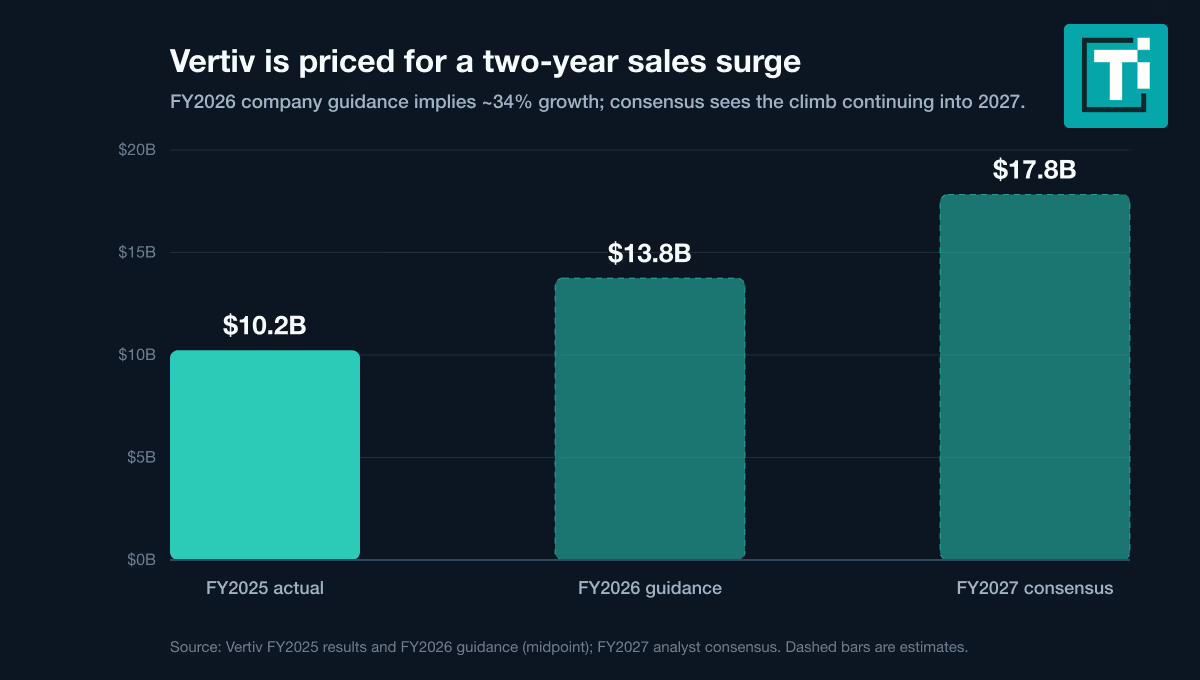
The fundamentals justify a good deal of the enthusiasm. In the first quarter of 2026, Vertiv reported $2.65 billion in net sales, up 23% organically, with adjusted operating margin expanding more than four points to 20.8% and adjusted earnings per share of $1.17 — up 83% year over year. Adjusted free cash flow more than doubled. For the full year 2025 the company did $10.23 billion in sales, up 26% organically, with adjusted EPS of $4.20. This is not a story stock waiting for a model to come true; the cash and the margins are already here.

Guidance is where the AI premium shows up. Alongside those Q1 results in April, Vertiv lifted its full-year 2026 outlook for the second time, to roughly $13.5–$14.0 billion in sales — about 34% growth at the midpoint — with adjusted operating margin guided toward 23% and adjusted EPS around $6.35. Consensus then carries the line higher into 2027, near $17.8 billion. A company compounding sales at 30%-plus while expanding margins is rare in industrials, and it is the engine under the stock.
Profitability is scaling with the top line, not lagging it. Vertiv’s 2025 adjusted operating margin reached about 20.4%, up roughly a point, and adjusted free cash flow rose about two-thirds to $1.9 billion — the kind of cash generation that funds bolt-on deals like ThermoKey without strain. The company pays only a token dividend; the capital is going into growth and the balance sheet, which is what shareholders paying this multiple should want to see.
The backlog is the bull case — and the tell
The single most important figure is the one that does not show up in a quarter’s revenue: the backlog. Vertiv ended 2025 with about $15.0 billion in orders not yet shipped, up roughly 109% year over year, with a fourth-quarter book-to-bill near 2.9 — meaning new orders came in at nearly three times what the company billed. That is the visibility investors are paying for: a year and a half of demand already signed.
It is also the tell. A backlog of that size is only as good as the customers behind it, and Vertiv’s are concentrated among the hyperscalers and AI builders pouring capital into data centers. That spending has been a one-way street, but it is discretionary. The number to watch is not the backlog’s size but its direction — whether orders keep outrunning shipments. The next read comes with second-quarter results on July 29.
Book-to-bill above 1 is the metric that separates a real demand cycle from a sugar high. Vertiv’s reading near 2.9 in late 2025 means orders arrived almost three times as fast as it could ship them — a backlog that is still building, not draining. Sustained readings like that are why management felt able to raise guidance twice. They are also why any slip back toward 1 would be read as the cycle topping out, no matter how strong the headline revenue looks that quarter.
Where the competition is coming from
Vertiv has a lead, not a monopoly, and the pressure arrives from three directions:
- The full-stack rivals. Schneider Electric and Eaton both sell power and cooling end-to-end and are pushing hard into liquid cooling — Eaton bought Boyd’s thermal business in early 2026 to do it. They are the most direct competitors and far larger companies overall.
- The specialists. nVent, Munters, Modine, Rittal and a crop of liquid-cooling pure-plays compete on individual pieces of the thermal chain, while Super Micro and Delta integrate cooling directly into the server.
- The customers themselves. The hyperscalers design more of their own infrastructure every year. Anything they bring in-house is demand Vertiv does not capture — the long-term ceiling on any merchant supplier.
What makes Schneider and Eaton dangerous is scale: each is a far larger, more diversified electrical company that can subsidize a cooling push and bundle it into existing utility and building relationships. Vertiv’s counter is focus — it is the closest thing to a pure-play on AI-era power and thermal, with the Nvidia reference-design wins to show for it. Focus is an edge while the wave builds and a liability if it breaks, because a diversified rival can wait out a downturn that a concentrated one has to absorb.
The valuation is the whole debate
Everything good about Vertiv is, by now, in the price. At about $333 the stock carries a market cap near $128 billion and trades around 48 times forward earnings and well over 80 times trailing — roughly a five-year valuation high, and a steep number for a company that, GPU tailwind aside, makes industrial hardware. The multiple is not irrational; it is a bet that the build-out compounds for years. But it leaves little room for a stumble.

Wall Street is firmly on the bull side. Across 26 analysts the average 12-month target sits near $378, with a high of $500 and a low of $236 — an unusually wide spread that captures the debate exactly. The recent leg up traced partly to a fresh bullish initiation from Bernstein at $416. The average implies mid-teens upside from the June close; the low target implies the multiple, not the business, is the risk.
The risk that isn’t on the hero slide
Vertiv investors have a recent, specific reason for caution that the current momentum tends to bury. In 2022, the company repeatedly under-priced inflation and supply-chain costs, cut guidance more than once, and watched its stock fall about 71% — far worse than the broad market that year — before a management change brought in Giordano Albertazzi as CEO. Execution since has been excellent, and the operating discipline today looks nothing like 2022. But the episode is the reason a guidance-dependent, high-multiple stock like this deserves a discount for credibility risk rather than a premium for it. With a beta near 2, VRT moves hard in both directions, and a single soft quarter against a 48x multiple is the scenario the bears are paid to imagine.
What to watch on July 29
Vertiv reports second-quarter results on July 29. Skip straight to these lines:
- Orders and book-to-bill. The backlog only matters if it keeps growing. A book-to-bill that stays above 1 says the AI demand wave is still building.
- Liquid-cooling mix. Any color on how fast direct-to-chip and CDU revenue is scaling speaks to the durability of the lead as densities climb.
- Margin trajectory. The path toward the ~23% adjusted operating margin guide is what justifies the multiple; a stall would not.
- Hyperscaler signals. Management commentary on customer capex plans is the best early read on whether orders hold.
- Guidance. A third raise would confirm the momentum; merely reaffirming the current outlook could be enough to cool a stock priced for more.
Vertiv is the rare AI-infrastructure name where the business is already excellent and the only real argument is the price. The backlog says demand is real and visible; the margins say the company can convert it; the valuation says most of that is spoken for. It is best understood as a leveraged bet on AI capital spending staying aggressive — the same trade that pairs it with the power names feeding the grid. For the live price, targets and how it screens against the rest of the AI data-center power complex, Vertiv’s quote page carries the current numbers.
This article is market analysis, not investment advice. VRT is a high-beta stock trading near a five-year valuation high, and its outlook depends on AI data-center capital spending that can slow without warning. Verify current prices and primary company filings before making any decision.