
The most-owned trade in the market is the AI chip — Nvidia, the accelerators, the names every investor can recite. Underneath it sits a quieter business almost no one talks about: the companies that make the machines and materials used to build those chips in the first place. On June 18, that layer had its moment. Entegris jumped about 13.6%, KLA rose 8.7%, and the rest of the equipment complex — Applied Materials, Lam Research, ASML — went up with them. It was the market remembering that every AI chip starts as a blank silicon wafer, and someone has to sell the tools and chemistry that turn it into a processor.
These are not household names, and that is the point. Semiconductor capital equipment — “semicap,” in the trade — is the deepest layer of the AI supply chain and one of the least crowded. The catch, after a session like that, is that “uncrowded” and “cheap” are not the same thing. Both Entegris and KLA closed above what the average analyst thinks they are worth, in an industry with a long history of breaking the investors who bought the top of a cycle.
Article Brief
Key Takeaways
5 Points30s Read
- The moveEntegris rose ~13.6% to a record near $179 and KLA ~8.7% to ~$260, leading a broad semicap rally on June 18.
- The causeA sector-wide AI risk-on day — a US chipmaking announcement, memory upgrades, an Iran deal — plus a Mizuho target bump on Entegris, not company-specific news.
- The tradeEquipment and materials are the base of the AI stack; Entegris sells recurring consumables, KLA sells the inspection every advanced chip needs.
- The engineSEMI sees wafer-fab-equipment spending hitting a record ~$125.5B in 2026, driven by AI logic and the memory build-out.
- The catchKLA just split 10-for-1, both stocks trade above their average targets, and semicap is among the most cyclical groups in tech.
What actually happened on June 18
It helps to be honest about the trigger, because the popular version is wrong. This was not a day where Entegris dropped a blockbuster announcement. It was a sector-wide melt-up in anything tied to US chipmaking, and Entegris rode it harder than most. Three things happened at once: President Trump said Apple had agreed to build chips with Intel in the United States, lifting the entire domestic semiconductor chain; a wave of analyst upgrades hit the memory makers as DRAM and NAND prices kept climbing; and a US–Iran agreement eased oil and inflation fears, sending risk assets broadly higher.
On top of that macro lift, Entegris got a company-specific nudge: Mizuho raised its price target to $180 and lifted its wafer-fab-equipment estimates, calling Entegris a top-positioned materials name for the upcycle. (The Entegris–JSR cross-licensing deal on EUV photoresist materials that some write-ups credited for the pop was actually announced back in late May, a prior tailwind rather than the day’s catalyst.) When a whole sector jumps on macro and read-throughs rather than earnings, the durable question is not “what was the catalyst” — it is whether the multi-year demand behind it is real. For semicap, it is.
The Apple–Intel news was also more than a sentiment boost for this group specifically. Every new or expanded US fab — part of Intel’s broader push to win foundry customers — is a multibillion-dollar order book for tools and a recurring one for materials. Reshoring chip production is, mechanically, a subsidy for the companies that equip the factories. That is why a foundry headline moves Entegris and KLA at all: more fabs, wherever they are built, means more of exactly what these two sell.
The layer beneath the layer
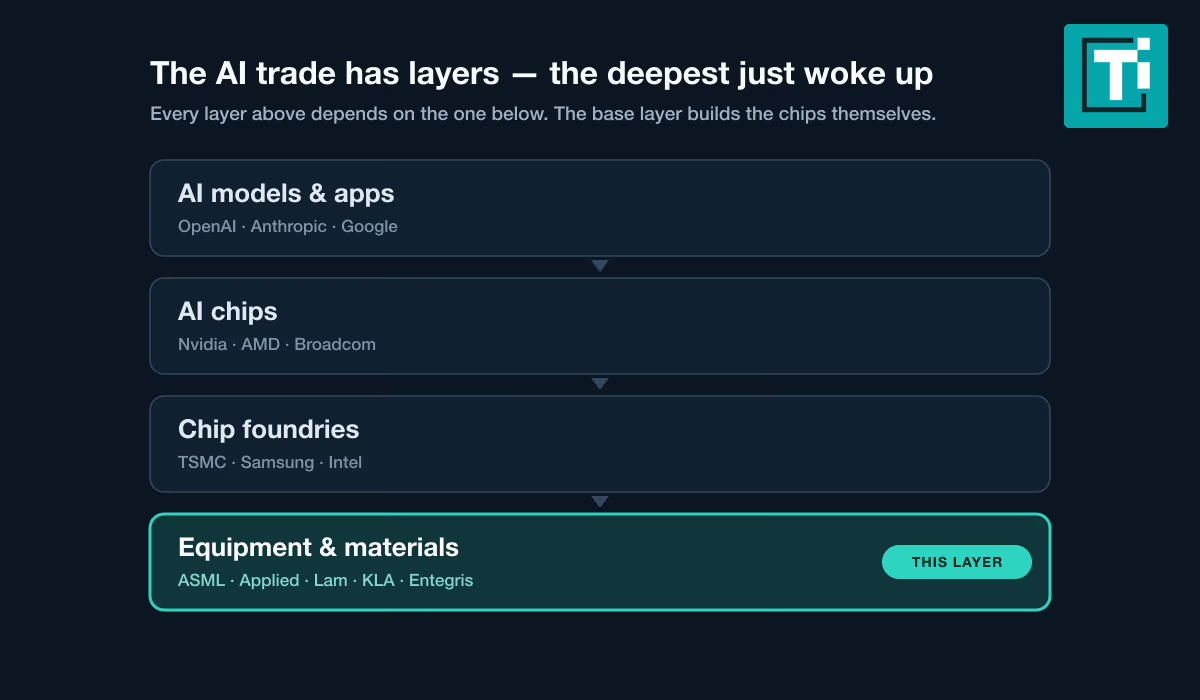
It is worth picturing where these companies sit. At the top of the AI economy are the models and apps; below them, the accelerators that train and run them; below those, the foundries — TSMC, Samsung, Intel — that fabricate the silicon. And underneath all of it is the equipment-and-materials layer that actually builds the fabs and feeds the production lines. Each layer depends entirely on the one beneath it. You cannot make more AI chips without more tools, more wafers, and more of the chemistry that etches and cleans them.

What makes this layer a distinct trade, rather than just a derivative of Nvidia, is its structure. Each niche is an oligopoly — a handful of vendors with decades of process knowledge and customer lock-in that newcomers cannot easily breach. ASML is the only company on earth that makes EUV lithography machines. KLA dominates the inspection that catches defects. And the materials side, where Entegris lives, sells consumables that fabs reorder every single day a line is running. Less hype than the chip designers, more of the durable economics of a toll road.
Why this can beat owning the chipmakers
There is a structural argument for owning this layer over the chips themselves: the equipment and materials vendors are agnostic about which chip wins. Whether the dominant AI accelerator of 2027 comes from Nvidia, AMD, a hyperscaler’s in-house silicon, or a startup nobody has heard of yet, it still has to be fabricated on the same handful of tool platforms and inspected by the same process-control systems. Semicap is a bet that the world makes more advanced chips, full stop — not a wager on the outcome of a brutal competition one layer up. In a market where picking the AI winner is genuinely hard, selling shovels to every miner is the more forgiving position.
That logic is strongest on the materials side. A chipmaker’s tool budget is cyclical and lumpy — it orders a wave of equipment to build a fab, then little until the next one. Its consumables bill is not: filters, slurries, specialty gases and process chemicals get used up and reordered every day a line runs. That gives a company like Entegris a smoother, more recurring revenue base than the boom-and-bust tool vendors, and it is a large part of why its shares command the premium multiple they do. It is roughly the difference between selling someone a printer once and selling them the ink for as long as they keep printing.
The two ways the rally split: Entegris and KLA
The two leaders are different businesses, and the difference is the whole investment case. Entegris is a materials and purity company: filtration, advanced materials, specialty chemicals and gases, and the CMP slurries and pads (through its CMC Materials franchise) that polish wafers flat between layers. Crucially, that revenue scales with wafer starts and process complexity, not with one-off tool purchases — so it is far more recurring than the lumpy equipment cycle. In its most recent quarter, Entegris reported $811.9 million in revenue, up 5%, with a gross margin near 47% and operating margin expanding to 17.4%. The memory super-cycle lifting DRAM and NAND prices is a direct tailwind: every additional layer in a 3D NAND stack and every new wafer start means more of Entegris’s consumables get used.
KLA is the opposite end of the chain: process control, the inspection and metrology that checks whether each chip is being made correctly. It is overwhelmingly the leader — management describes its position as more than seven times the size of its nearest competitor — and the business scales with complexity. The harder chips get to manufacture, the more inspection steps they need, which is why advanced packaging and the high-bandwidth memory that sits beside AI accelerators are such a tailwind. KLA expects its advanced-packaging process-control revenue to grow from roughly $635 million toward $1 billion this year. In its latest quarter it did $3.42 billion in revenue, up 11.5%, with process control about 90% of the total. One housekeeping note that confuses newcomers: KLA completed a 10-for-1 stock split on June 12 and raised its dividend 21%, which is why a stock that used to trade in four figures now sits near $260.
The demand engine: a record equipment cycle
Behind both names is the same number: how much the world spends building chips. That figure is climbing to records. SEMI forecasts global wafer-fab-equipment spending of about $125.5 billion in 2026, up roughly 9% from 2025, rising again to $135.2 billion in 2027 — driven by leading-edge AI logic, the memory-capacity build-out, and advanced packaging. The memory super-cycle is the part that feeds straight into this: memory makers cannot expand output without buying tools and consumables, and the sharp run in DRAM and NAND prices is the clearest signal that they will, even if the equipment orders arrive on a lag of a few quarters.

The catch: cyclicality, China, and a run past the Street
For all the structural appeal, this is where the enthusiasm needs a cold towel. Start with valuation: after Wednesday, both leaders trade above the average analyst price target — Entegris near $179 against a mean around $161, KLA near $260 against a mean near $201. Targets lag fast rallies, and the latest upgrades are still catching up, but a stock that has outrun the Street is not a stock with a wide margin of safety. Entegris trades at more than 100 times trailing earnings; KLA in the seventies.
Then there is the nature of the business. Wafer-fab-equipment spending is one of the most cyclical lines in all of technology — it booms when fabs expand and falls off a cliff when they pause, and the stocks move with a beta to match. Buying the group the day after a 13% pop is, by definition, buying strength. Layered on top is policy risk that is unique to this corner of the market: US export controls on advanced chipmaking gear to China are a permanent overhang, and China is still roughly a quarter of KLA’s revenue and a meaningful slice of Entegris’s. A single headline tightening those rules can reprice the whole group overnight.
The strongest bull rebuttal is that this cycle is built differently from the busts that scarred the group before. Past memory-driven downturns came from oversupply — fabs added too much capacity, prices crashed, and orders evaporated. This expansion is demand-led: AI compute and memory are short, not glutted, and the binding constraint is how fast new capacity can come online, not whether it is needed. If that framing holds, the next down year is shallower than the group’s history implies. If it is wrong — if AI spending front-loaded demand that later air-pockets — the old script runs again, and these stocks are priced for the optimistic version of events, not the cautious one.
What to watch from here
The thesis is structural, but timing is everything in a cyclical group, and it turns on a handful of data points worth marking on a calendar:
- Earnings, late July. Entegris reports fiscal Q2 and KLA its fiscal Q4 — the first fundamental reads to confirm the rally, and the place any China or order softness would show up first.
- WFE forecast revisions. Updates from SEMI and from the toolmakers’ own guidance are the cleanest gauge of whether the spending cycle is still accelerating.
- Memory capex. The memory makers driving so much of the demand are committing capital now; watch their build-out plans, not just their pricing.
- Export-control headlines. Any change to US rules on selling advanced equipment into China is the single fastest way to reprice this group.
- The broad chip tape. Much of June 18 was macro. If the wider AI-chip rally cools, the high-beta equipment names tend to give back more than they gained.
The semicap rally is the market following the AI money one layer deeper than usual — past the chips, past the fabs, to the companies that make it all physically possible. It is a real, durable trade with an oligopoly’s economics and a record spending cycle behind it. It is also a cyclical, policy-exposed group that just ran past what analysts thought it was worth in a single session. Both things are true, and the gap between them is the risk. For long-term investors, the layer is one of the more defensible ways to own AI hardware; for anyone chasing the June 18 candle, the late-July earnings and the next export-control headline matter more than the breakout did. The structural story and the entry point are two different decisions, and conflating them is how cyclicals catch people out. For the live price and targets as the next earnings approach, the Entegris quote page carries the current price and the latest analyst targets.
This article is market analysis, not investment advice. Semiconductor-equipment stocks are deeply cyclical and exposed to export-control policy; ENTG and KLAC have risen sharply and both trade above their average analyst price targets. Verify current prices and primary company filings before making any decision.