Tesla began charging passengers for driverless Cybercab rides in Austin, and within about a day the federal regulator opened a file on whether the vehicle was ever entitled to be on the road.
The National Highway Traffic Safety Administration announced an Audit Query into Tesla’s certification that the Cybercab meets all applicable Federal Motor Vehicle Safety Standards. The agency was explicit that the trigger was commercial deployment: “The enforcement action follows Tesla’s commercial deployment of its driverless Cybercab vehicles in Austin, Texas.”
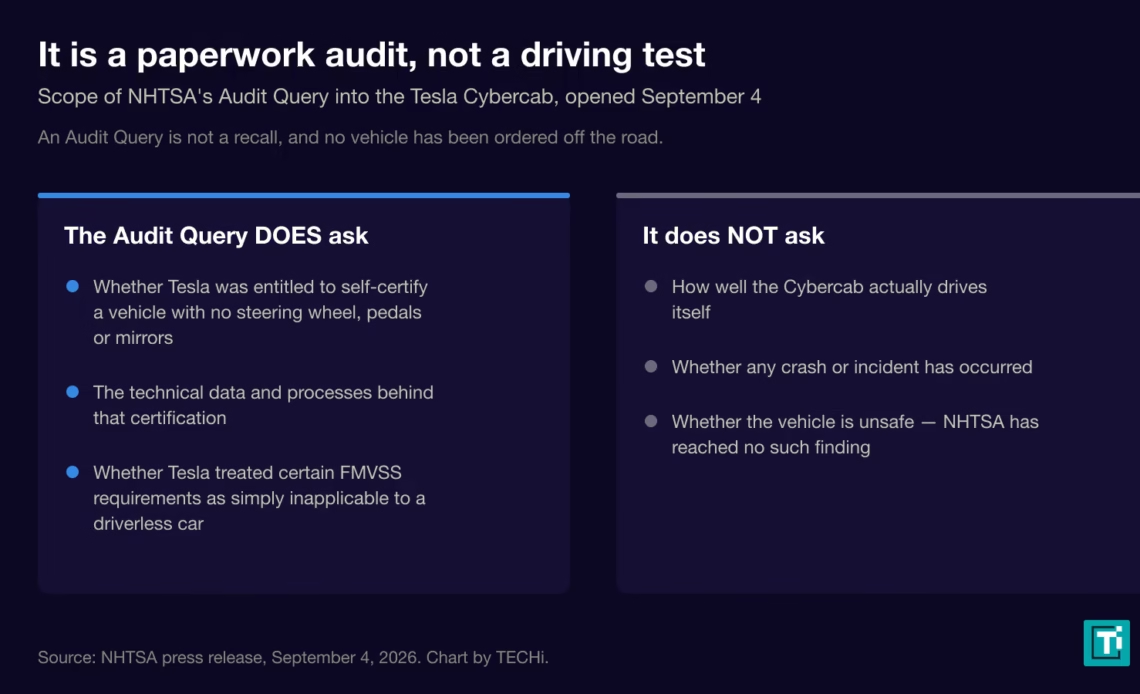
Read the headlines and this looks like a safety investigation. It is not. The audit does not examine how well the Cybercab drives. It examines paperwork — specifically, whether Tesla was allowed to declare a car with no steering wheel, no pedals and no mirrors compliant with standards written for cars that have all three.
Article Brief
Key Takeaways
5 Points30s Read
- What happenedNHTSA opened an Audit Query into Tesla’s self-certification that the Cybercab meets all applicable Federal Motor Vehicle Safety Standards, a day after paid rides began in Austin.
- What it is notThe audit does not test how the Cybercab drives. It is not a recall, and NHTSA has not concluded the vehicle is unsafe or illegally deployed.
- The actual questionWhether Tesla was entitled to declare a car with no steering wheel, pedals or mirrors compliant with standards written for cars that have them.
- The timing betNHTSA says it has eight rulemakings underway to remove AV barriers — but that “until that work is completed, existing standards remain in force.”
- Why it mattersThe cheapest path to scale runs through purpose-built vehicles with no controls, against 2026 capex guided above $25 billion.
Self-certification is the whole mechanism
The United States does not pre-approve cars. NHTSA lays out the performance requirements and manufacturers certify their own compliance, with the agency auditing afterward. The press release states the model plainly: automakers “must certify that their vehicles meet these standards – subject to oversight from the agency to confirm compliance. When certified vehicles appear to not adhere to these requirements, NHTSA conducts an investigation.”
That system is fast and permissive by design. It is also the reason this particular question is so sharp. Tesla did not receive permission to deploy the Cybercab. Tesla asserted that the Cybercab was already legal, and the audit asks whether that assertion holds.
The agency described what it will look at: it will “evaluate the technical data and processes Tesla relied upon to self-certify compliance for a vehicle lacking traditional human controls,” and will “examine whether Tesla’s compliance framework relied on determinations that certain standard FMVSS requirements are inapplicable to its automated vehicles.”
That last clause is the crux. Tesla appears to have concluded that a set of federal standards simply do not apply to a vehicle with no driver. That is a defensible legal reading. It is also, for now, Tesla’s own reading rather than the regulator’s.

The rules are being rewritten — just not yet
The part of the announcement that most coverage skipped is the part that best explains the timing.
NHTSA says it is already overhauling exactly these standards. “Over the last year, the agency announced it has begun working on eight rulemakings – including standards relating to brake pedals, windshield wipers, lighting, and rearview mirrors,” the release says, framed as part of an effort to “unleash American innovation” and remove “unnecessary barriers to American AV innovation in the coming months.”
Then comes the sentence that matters: “Until that work is completed, however, existing standards remain in force.”
Look at the four rulemakings the agency chose to name. Brake pedals. Windshield wipers. Lighting. Rearview mirrors. Those are close to a list of the human-driver hardware the Cybercab was designed without. The regulator is rewriting the rules in Tesla’s direction, and has said so publicly. It simply has not finished.
So this is not a regulator hostile to driverless cars catching a company out. NHTSA Administrator Jonathan Morrison put the posture on the record: “NHTSA fully supports the safe development and deployment of automated vehicles. But as the federal regulator, we need to ensure that all of our laws are followed.”
Tesla deployed into the gap between a rulebook being rewritten and the rewrite being finished. That is a timing bet, and it is a different kind of risk than the one investors usually price for this company.
Why this lands on the capital plan, not the software
Tesla’s autonomy thesis has always had two separable halves: whether the software can drive, and whether the company can manufacture and deploy purpose-built vehicles at scale. Most argument concentrates on the first. This audit is aimed squarely at the second.
The distinction matters because the capital is already committed. Management has guided 2026 capital expenditure above $25 billion and has been arranging roughly $30 billion of borrowing capacity behind it. In the June quarter, capital spending more than doubled to $5.79 billion and free cash flow turned negative by $1.09 billion — Tesla’s first cash-burning quarter since early 2024 — while operating expenses rose 47%. TECHi covered that quarter as a record revenue line with the AI bill taking the profit.
Shareholders then approved a pay package for Elon Musk reported at up to $1 trillion, carried with roughly 75% support and tied in part to delivering a million Optimus robots within a decade. Whatever else that package is, it is an instruction to scale physical units.
A fleet of purpose-built two-seaters with no controls is the cheapest version of that plan. Retrofitted Model Ys are the expensive version. If self-certification for a no-controls vehicle does not survive audit, the cheap path narrows until the rulemakings land — and the spending schedule was not written to wait.
The economics are not subtle. Every control the Cybercab omits is a part not bought, a subsystem not validated, and weight not carried: no steering column, no pedal assembly, no mirrors, no wiper mechanism. That is the entire reason to build a bespoke robotaxi rather than convert an existing model. Strip the omissions away and the vehicle converges on a normal car with a computer in it, which is the configuration Tesla already sells and which has never produced robotaxi-scale margins. The certification question is therefore also the unit-cost question.

What is actually deployed
Against all of that, the operating reality is modest. Public Cybercab rides opened in Austin on September 3 and 4 inside a limited pickup zone, with only around 45 of the two-seaters reported as registered in Texas, and the audit reported to cover roughly 1,000 vehicles.
The event that accompanied the launch did not help. It was invite-only, was not streamed, and Elon Musk never appeared. Tesla shares fell about 6% as investors read the update as thin against a robotaxi market currently led by Alphabet’s Waymo. The federal inquiry landed the same day.
Two years passed between the Hollywood-style Cybercab unveiling and a paying passenger. What arrived is 45 cars in one city, in one zone, with a federal file open on their legal basis.
TECHi has already written about the other half of this gap — that the robotaxi works, but not on the cars Tesla sold you, because the hardware in customer vehicles cannot do what the purpose-built car does. The audit adds a second constraint on top of the first. The car that can do the job is the car whose legal basis is now under review.
Shares closed Friday at $365.44, up 0.5% on the day, which tells you the market is not currently pricing this as an existential question. Analysts remain widely split on the name, as TECHi found when price targets spanned an extraordinary range after the second quarter.
What would change the read
Three outcomes are worth separating, because they are not equally likely and they are not equally bad.
If NHTSA finishes its eight rulemakings before the audit concludes, much of this becomes moot. The standards get rewritten around vehicles without human controls, and Tesla’s early reading is vindicated by the rules catching up. The agency has said it wants that done “in the coming months,” which is not a date.
If the audit finds the self-certification was improper under the standards as they currently stand, the consequences attach to hardware rather than to code. That is the scenario where a redesign or a fleet action becomes possible, and it would fall on the vehicle Tesla’s cheapest scale path depends on.
That asymmetry is the part worth internalising. A software problem in an autonomous fleet is fixed the way Tesla fixes most things, with an over-the-air update pushed overnight. A certification problem is not. It attaches to metal already built, to tooling already ordered, and to a production line configured to stamp out a body shell that may need a component the design deliberately omits. Nothing about the driving stack changes the answer.
The middle outcome is probably the most likely and the least dramatic: the audit runs long, Tesla keeps operating a small Austin fleet inside a limited zone, and nothing is resolved until the rulemakings are. That outcome costs Tesla time rather than money, but time is what a $25 billion annual capital plan is least able to absorb.
Two things are worth watching, and neither is the share price. The first is the registered Cybercab count and whether the Austin pickup zone widens — fleet expansion while an audit is open would signal Tesla’s confidence in its own reading. The second is the rulemaking docket, because the moment the standards covering pedals and mirrors are finalised, the legal question underneath all of this largely dissolves.
An Audit Query is not a recall. NHTSA has not concluded the Cybercab is unsafe or illegally deployed, and it has not ordered anything off the road. What it has done is decline to treat Tesla’s own legal reading as settled. For a company whose entire scale case runs through a vehicle with no steering wheel, that is the fact worth tracking — more than the day’s move in the stock.