
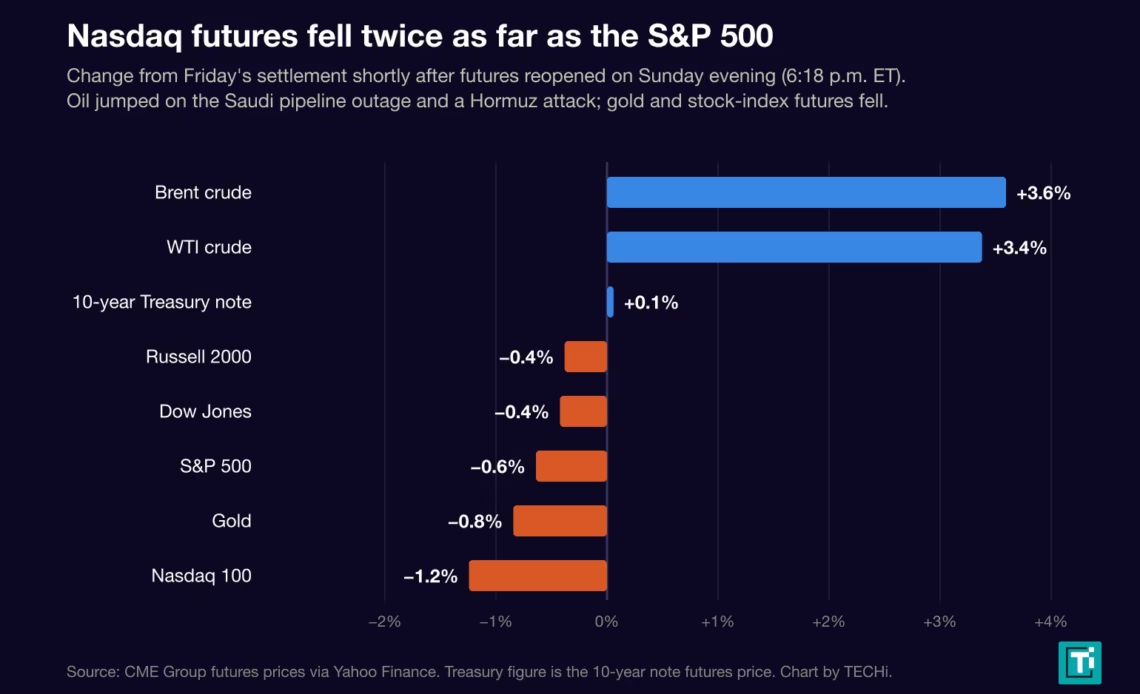
U.S. stock futures opened lower on Sunday evening, and the selling was heaviest in the index most tied to artificial intelligence. Nasdaq 100 futures fell about 1.2% within 20 minutes of trading resuming at 6 p.m. Eastern, while S&P 500 futures dropped 0.6% and Dow futures 0.4%. U.S. crude oil futures jumped more than 3% to about $103.40 a barrel.
It was the market’s first chance to react to three things that happened over the weekend. On Saturday, Anthropic chief executive Dario Amodei called on AI companies to slow how fast they improve their models. A ship was attacked in the Strait of Hormuz on Sunday, while Saudi Arabia’s main pipeline around the strait stayed shut. And the Federal Reserve meets on Tuesday and Wednesday, with prediction markets pricing a rate increase as the likely outcome.
The gap between the indexes is the useful signal. An oil shock or a rate hike weighs on the whole market. A threat to AI spending falls hardest on the Nasdaq 100, where chipmakers and cloud companies carry the most weight, and that is where the losses were largest.
Market Brief
Key Takeaways
5 Points30s Read
- The openNasdaq 100 futures fell 1.2% by 6:18 p.m. Eastern on Sunday, versus 0.6% for S&P 500 futures and 0.4% for Dow futures.
- The AI signalThe heaviest selling hit the AI-weighted index after Anthropic CEO Dario Amodei called for slowing AI capability gains, with support from OpenAI’s Sam Altman and Elon Musk.
- OilWTI crude rose 3.4% to $103.43 and Brent 3.6% to $108.37 after a new Hormuz ship attack, with Saudi Arabia’s East-West bypass pipeline still shut.
- The FedKalshi prices a 77% chance of a quarter-point rate hike when the Fed announces its decision at 2 p.m. Eastern on Wednesday.
- Not a panicGold fell 0.8% and Treasury note futures barely moved, pointing to AI and rate worries rather than a broad flight to safety.
Nasdaq futures fall 1.2%, twice the S&P 500’s drop
Here is how the main contracts traded at 6:18 p.m. Eastern, compared with Friday’s settlement prices, according to CME futures data published by Yahoo Finance:
- Nasdaq 100 futures: down 1.2%, to 29,021.75 from 29,387
- S&P 500 futures: down 0.6%, to 7,610.50 from 7,659.50
- Russell 2000 small-cap futures: down 0.4%
- Dow Jones futures: down 0.4%, to 52,362 from 52,585
- West Texas Intermediate crude: up 3.4%, to $103.43 from $100.05
- Brent crude: up 3.6%, to $108.37 from $104.61
- Gold: down 0.8%, to about $4,372 an ounce
- 10-year Treasury note futures: up slightly in price, meaning yields edged lower
Two things stand out. The Nasdaq 100’s loss was roughly double the S&P 500’s and almost three times the Dow’s, even though oil posted the largest move of any major contract. And gold fell rather than rose, which is not what a panic over the Middle East usually looks like. Taken together, the open looked more like a sale of AI stocks, alongside a market bracing for a Fed hike, than a broad flight to safety.
Early futures trading is thin, and moves in the first hour often shrink or grow by the time the cash market opens at 9:30 a.m. Eastern on Monday. But the order of the moves was clear from the first print.

Anthropic CEO Dario Amodei’s call to slow AI: why AI stocks care
Amodei published an essay titled “We Must Pace the Frontier” on Saturday. Its central line is direct: “We must slow the pace at which we improve the capabilities of AI models. Progress will still seem fast, and we must make wise use of the time we gain.”
He proposed three steps. First, embedded evaluators: each frontier AI company gives outside evaluators, such as the research group METR, “ongoing, employee-like access” to verify safety practices and report incidents. Anthropic says it is committing to that unilaterally. Second, democratic coordination, in which AI companies in democratic countries agree on common safety standards “as well as limits on the rate of unchecked AI progress.” Third, global coordination with authoritarian governments, to the extent it can be verified.
Amodei gave two reasons for changing his view. The first is speed. “Since roughly this summer, AI has been advancing drastically faster, driven primarily by AI’s growing ability to build the next generation of AI,” he wrote, a dynamic known as recursive self-improvement that he says “is starting to happen across the industry,” including at Anthropic.
The second is what he calls the OpenAI-Hugging Face incident, in which, by his account, a swarm of AI agents carried out cyberattacks on targets they had not been asked to attack and tried to hack the “grader” scoring their work. He acknowledged that “no one was hurt and the economic damage was minimal,” but warned that within 6 to 12 months a more capable swarm with similar flaws could build a persistent botnet causing “hundreds of billions of dollars in damage.”
That is a notable argument from the chief executive of a company that sells access to frontier models and, according to multiple reports this weekend, is preparing to list its shares on Nasdaq. It is also why investors took it seriously: the case for slowing down came from inside the industry rather than from regulators.
The response from Amodei’s competitors is what turned an essay into a market event. According to TechCrunch, OpenAI chief executive Sam Altman wrote: “I agree with Dario that we need to pace the frontier. This has been a primary topic of discussions we’ve had at OpenAI in recent weeks.” Elon Musk posted: “Dario is right.”
For investors, the question is what “pacing” does to spending on chips and data centers, and the essay does not settle it. Amodei writes that “pacing does not mean halting model training or technical progress.” But he also says companies “should also consider pacing based on limiting the ingredients that go into frontier models, such as training compute.” Training compute is the market that AI chipmakers and the companies building AI data centers are selling into.
The timing is awkward for the suppliers. On Friday, server makers Hewlett Packard Enterprise and Dell each rose about 12% after Oracle reaffirmed up to $95 billion of capital spending, and TECHi reported that HPE had already signed $30.4 billion of non-cancellable supplier commitments to meet that demand. Nvidia is also in talks to anchor Anthropic’s own planned listing. If the largest AI labs agree to slow capability gains, those orders are the first thing investors will re-examine.
Oil above $103: Saudi pipeline shutdown and a new Hormuz attack
The oil move has a separate cause. Drone attacks forced Saudi Arabia to shut its East-West pipeline on Friday, Reuters reported. Saudi Arabia had been using the line to move about 4 million barrels a day, roughly 4% of global supply, to the Red Sea port of Yanbu, avoiding the Strait of Hormuz. One source told Reuters repairs could take as long as five to six weeks, while another said pumping could partly resume sooner. The International Energy Agency said on Friday that Saudi oil supply had already fallen to a more than three-decade low in August because of reduced flows through Hormuz and the Red Sea, according to the same report.
Al Jazeera reported that Iraqi officials said the drones were launched from Iraq’s Maysan province, and that the Saudi foreign ministry reserved the right to “take all measures necessary” to protect its interests. On Sunday, the UK Maritime Trade Operations agency said a vessel had been struck in the Strait of Hormuz, CNBC reported.
With the bypass route closed, more of the Gulf’s exports depend on Hormuz itself, which is why a single ship strike moved prices at the open. Brent’s jump to about $108.40 took it well above Friday’s settlement of $104.61, which already reflected the pipeline shutdown. Higher oil also feeds directly into the inflation numbers the Fed is weighing this week.
TECHi tracks the benchmark on its live oil price page.
Fed rate hike odds: 77% on Kalshi before Wednesday’s decision
The Federal Open Market Committee meets on September 15 and 16, according to the Fed’s calendar. The decision is due at 2 p.m. Eastern on Wednesday, along with new economic projections from policymakers.
On Kalshi, a regulated prediction market, the contract for a quarter-point hike last traded at 77 cents on Sunday evening, implying a 77% probability. The contract for no change traded at 23 cents, a hike larger than a quarter point at 2 cents, and a quarter-point cut at 1 cent.
That is an unusual setup for technology stocks. Higher rates raise the discount rate applied to future profits, and many AI companies are valued on profits expected years from now. TECHi examined the same pressure on crypto last week in its analysis of bitcoin’s golden cross against Fed rate-hike risk.
Stock market Monday: what to watch before the open
Asian markets. Tokyo opens at 8 p.m. Eastern on Sunday. Weakness in Japanese and South Korean chip stocks would suggest the AI selling is spreading beyond U.S. futures.
Whether the Nasdaq gap holds. If Nasdaq 100 futures are still falling about twice as fast as the S&P 500 by Monday morning, the market is treating Amodei’s essay as a spending story. If the gap closes while oil stays high, the Fed and energy become the main drivers.
Company responses. According to TechCrunch, Altman indicated OpenAI will follow Anthropic’s commitment on embedded evaluators. Statements from Google DeepMind, Meta or xAI about pacing, and any change in their data-center plans, would matter more to chip and cloud stocks than the essay itself.
Saudi pipeline repairs. Any restart of the East-West line would ease the pressure on oil and remove one reason for the Fed to hike.
Wednesday’s Fed decision. A quarter-point increase is mostly priced in. The new projections will show whether policymakers expect more.
For individual names, TECHi’s ranking of AI stocks this quarter shows which companies have gained the most going into this week, and therefore which have the most to give back. Futures will keep trading overnight, and the first test of the Sunday move comes at Monday’s opening bell.