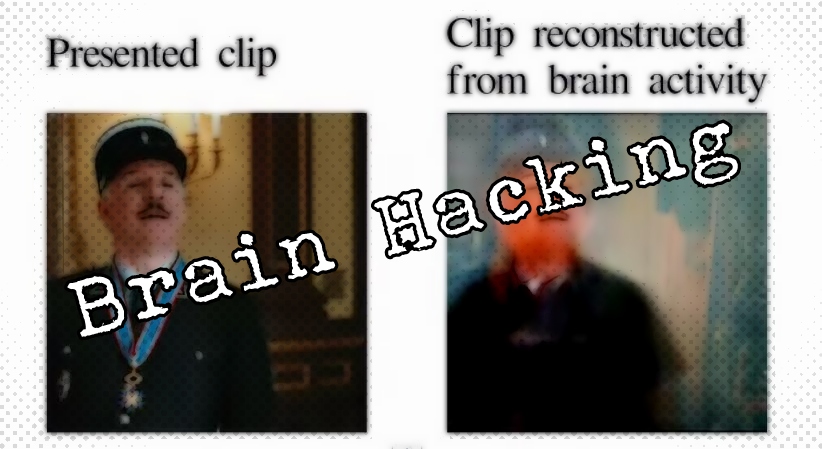
The UC Berkeley researchers have succeeded in decoding the images inside your mind and then reconstructing it to get the picture. The researchers made use of the Magnetic Resonance Imaging (MRI) and computational models to achieve this.
Currently this brain hacking methodology could be only used to reconstruct the video clips already watched but it is expected that this could be further developed to reproduce the images that nobody else sees- yes, remembering the forgotten dreams would be much easier then. Congratulations. The neuroscientist and coauthor of this study Professor Jack Gallant writes in the journal current biology: “This is a major leap toward reconstructing internal imagery. We are opening a window into the movies in our minds.” As shown in the video, the person is shown watching Hollywood trailers and the images are shown on the PC.
“Our natural visual experience is like watching a movie. In order for this technology to have wide applicability, we must understand how the brain processes these dynamic visual experiences,” said Shinji Nishimoto, lead author of the study. He and his other two team members served as a subject for this brain hacking experiment and they had to remain inside the MRI scanners for hours.
During the experiment they were made to watch two different set of Hollywood trailer and fMRI was used to calculate the amount of blood flow through the part of the brain that takes care of visual information and interpretation (visual cortex). On the PC, the brain of the subjects were divided into tiny parts for brain hacking study and the information were studied.
“We addressed this problem by developing a two-stage model that separately describes the underlying neural population and blood flow signals,” Nishimoto said. “We need to know how the brain works in naturalistic conditions,” he said. “For that, we need to first understand how the brain works while we are watching movies.” The study doesn’t forget to highlight the fact that actual brain hacking would take years to materialize.
Now let me tell you about some more constructive applications of this brain hacking technology. This path-breaking technology could be used to look inside the brain and understand what people can’t communicate verbally during the situations like heart attacks, coma patients and more. Brain hacking would also open gateways for developing advanced brain-machine interface to cure the neurodegenerative diseases.
Did this news about brain hacking excite you? Tell us in comments below.