Lihong Wang led a team of biomedical engineers to develop world’s fastest 2-D camera that can slow down the processes to 100 billion frames per second. The current ultrafast imaging techniques could capture up to 10 million frames per second.
The research featuring in the
nature, the team of scientists have used a technology called Compressed Ultrafast Photography and took images of the four physical phenomenon of light: reflection, refraction, non-information (faster than light propagation) and photons racing in two media.
Wang said:
For the first time, humans can see light pulses on the fly. Because this technique advances the imaging frame rate by orders of magnitude, we now enter a new regime to open up new visions. Each new technique, especially one of a quantum leap forward, is always followed a number of new discoveries. It’s our hope that CUP will enab
le new discoveries in science — ones that we can’t even anticipate yet.
The applications of this super duper fast camera are multi-fold. This high-speed frame rate could be used in astronomy and forensics. Wang and his team complemented and added
algorithms to the existing technology known as ‘streak camera’ that measured the intensity variations of light with time in 1-D.
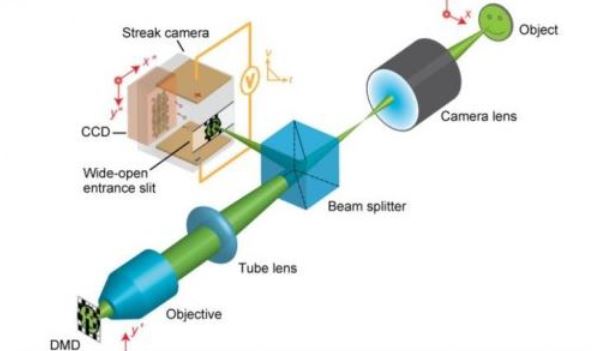
In the CUP technology, an object is photographed with a special lens, which captures the photons from the object and drives it through a tube-like structure to a tiny apparatus called a digital micromirror device (DMD), hosting about 1 million micromirrors. Each micromirror is seven-by-seven microns squared.
There, micromirrors are used to encode the image, then reflect the photons to a beam splitter, which shoots the photons to the widened slit of a streak camera. The photons are converted to electrons, which are then sheared with the use of two electrodes, converting time to space. The electrodes apply a voltage that ramps from high to low, so the electrons will arrive at different times and land at different vertical positions. An instrument called a charge-coupled device (CCD) stores all the raw data. All of this occurs at the breathtaking pace of 5 nanoseconds. One nanosecond is a billionth of a second.
The CUP technology could be used in integration with the current devices. This advanced technology would also help in the field of medicine and biochemistry. Combining CUP imaging with the
Hubble Telescope, we will get both the sharpest spatial resolution of the Hubble and the highest temporal solution with CUP and thus have never seen before images of the universe.
The world’s fastest camera can unfold world’s oldest mysteries. Did you find this intriguing? Tell us in comments below.