
Dell just gave AI hardware investors the number they wanted, and that is exactly why the stock is harder now. Demand is no longer the debate. The debate is whether the AI server boom can produce enough margin, cash flow and balance-sheet discipline to justify a stock that suddenly trades like the market has discovered a new infrastructure winner.
That is the more useful read after the print. This is not a simple “Dell beat earnings” story. It is a story about a business model changing in real time: a PC-and-enterprise infrastructure company becoming one of the public market’s largest AI server funnels, with all the excitement and all the lower-margin hardware math that comes with it.
TECHi’s AI stocks page showed Dell as the top provider-confirmed live mover, up about 35%, after the results. The separate Dell quote page had already been tracking a much smaller after-hours move from the prior snapshot, which is a reminder that the tape can move faster than static quote snapshots after a print this large. The direction, however, is not ambiguous: investors rushed to reprice Dell as an AI server beneficiary.
Article Brief
Key Takeaways
4 points24s read
- The moveTECHi’s live stocks page showed Dell as the top provider-confirmed mover, up about 35%, after a huge AI server quarter.
- The demand proofDell reported $24.4 billion of AI server orders, $16.1 billion of AI server revenue and a $51.3 billion ending AI backlog.
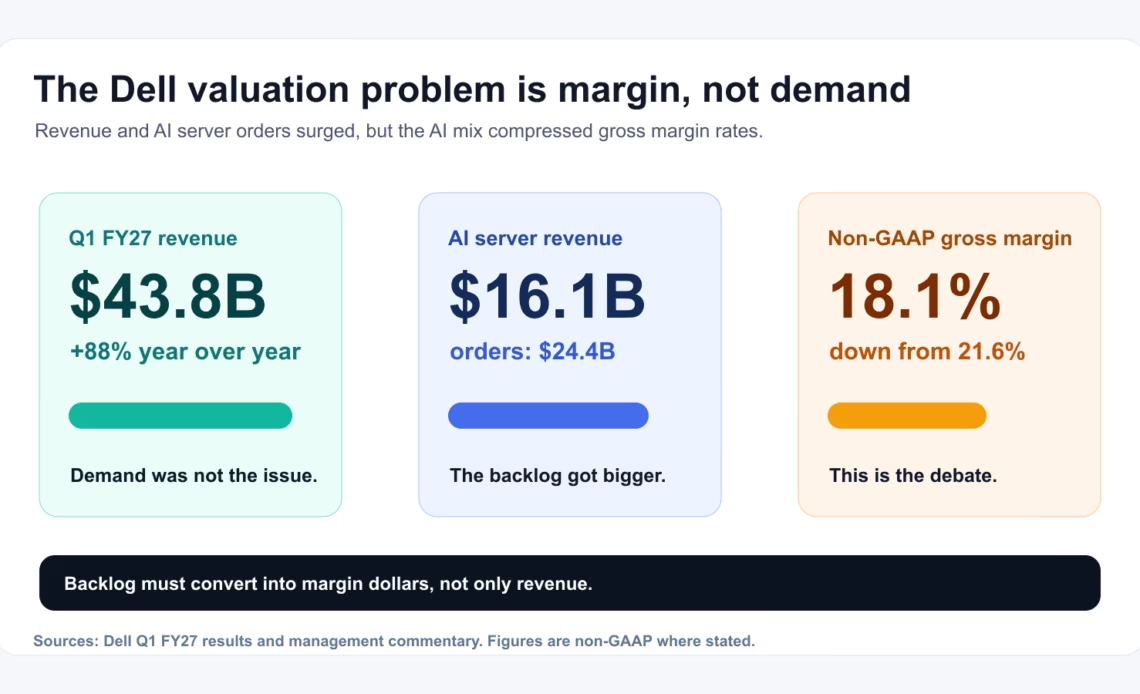
- The margin problemNon-GAAP gross margin fell to 18.1% from 21.6% a year earlier as AI servers became a much larger part of the mix.
- The next testThe stock now needs backlog conversion, working-capital discipline and margin dollars, not just another bigger AI number.
The beat was not subtle
Dell’s Q1 FY27 earnings release showed revenue of $43.8 billion, up 88% year over year. Diluted EPS was $5.24. Non-GAAP diluted EPS was $4.86. Cash flow from operations was $4.1 billion, and adjusted free cash flow was $3.165 billion.
The AI server numbers were the reason the stock moved. In the Q1 performance review, Dell reported $16.1 billion of AI server revenue, up 757% year over year, and $24.4 billion of AI server orders. In the prepared remarks, management said ending AI backlog reached $51.3 billion and raised fiscal 2027 AI server revenue guidance to $60 billion.
That is a monster demand signal. It also makes the valuation question less forgiving. Dell has already moved from “can it get AI orders?” to “can it convert those orders into returns?” The first question created the gap higher. The second question decides whether the gap survives.

The margin math is the story now
Dell grew revenue 88%, but GAAP gross margin fell to 17.8% from 21.1% a year earlier. Non-GAAP gross margin fell to 18.1% from 21.6%. That is not a failure. It is the natural cost of becoming a larger AI server business. AI servers can bring enormous revenue, but they also carry a different mix, more expensive components and more customer concentration risk than a clean software story.
Management tried to frame that distinction clearly. The prepared remarks said the gross-margin rate decline was driven primarily by a mix shift toward AI-optimized servers, while gross margin dollars still increased sharply. Dell also said it continues to target a mid-single-digit operating income rate for AI servers over time.
That target is now central to the stock. If Dell turns $60 billion of fiscal 2027 AI server revenue into acceptable operating profit, the company becomes one of the most important public-market infrastructure plays of the AI buildout. If the business scales mostly as pass-through hardware volume, the market may eventually decide the stock deserved a trade, not a permanent multiple reset.
The financing question did not disappear
This is where Dell’s older AI risk still matters. TECHi previously argued that the AI server boom was becoming a credit business. The latest quarter does not disprove that. It updates it. Dell generated strong cash flow, but the balance sheet also shows the scale of the machine it now has to run.
Inventories rose to $15.1 billion from $10.4 billion a year earlier. Accounts receivable rose to $25.9 billion from $17.6 billion. That is not automatically bad when demand is exploding, but it is the right place to look. AI server growth pulls capital into parts, manufacturing, customer delivery schedules and payment timing before the market can celebrate the revenue.
The good news is that Dell is not entering this phase from a weak capital position. It ended the quarter with $14.1 billion of cash and investments, a core leverage ratio of 1.2x, and returned $2.1 billion to shareholders through dividends and buybacks. The risk is not solvency. The risk is return quality. Investors need to know whether this bigger AI business keeps throwing off cash after the working-capital cycle catches up.

Backlog conversion is now the earnings model
The backlog number is huge, but backlog is not earnings. Dell expects Q2 revenue of $44 billion to $45 billion and Q2 AI server revenue of about $15.5 billion. It expects full-year revenue of $165 billion to $169 billion. Those targets imply that the AI server ramp is not a one-quarter spike; it is now embedded in the model.
That makes conversion more important than headlines. The question is not whether customers want AI systems. The question is whether Dell can ship them on time, get paid on acceptable terms, manage component supply, keep service and support costs under control, and avoid giving away too much profit to win scale.
This is also where the comparison with other AI infrastructure names becomes sharper. Dell has broader enterprise relationships than Super Micro, a larger financing apparatus, and a more mature services footprint. But it also has a giant PC and traditional infrastructure base that can blur the AI signal. A pure AI server boom can lift the multiple; a mixed hardware company still has to prove that the new growth is high quality.
Why this is not just another hardware cycle
The bullish argument is stronger than the usual server-cycle story because AI customers are not buying generic capacity. They are buying accelerated systems under supply pressure, with deployment windows tied to model training, inference demand and competitive urgency. That gives Dell a chance to sell into a more durable buildout than a normal enterprise refresh.
The bearish argument is also stronger than the usual server-cycle worry because the scale is so large. A company can grow revenue very quickly and still disappoint shareholders if each incremental dollar needs too much inventory, financing support or supplier coordination. Dell is not selling software seats. It is assembling, financing and delivering expensive infrastructure into a market where customers want speed and vendors compete hard on price.
That is why the next leg of the stock cannot be judged by revenue growth alone. The market needs to see margin dollars rise faster than balance-sheet intensity, not just a larger number on the AI server slide. If Dell can do that, the company deserves a different conversation. If not, investors may eventually call the quarter a historic order book attached to ordinary hardware economics.
What would make the rally stick
The cleanest positive signal from here would be boring execution: AI backlog shipping on time, Q2 AI server revenue near the $15.5 billion mark, ISG operating margin holding near or above the Q1 level, and adjusted free cash flow staying healthy after the inventory cycle. That combination would tell investors the AI buildout is not only boosting sales, but also improving Dell’s earnings power.
The warning signs are just as specific. A rising backlog paired with weaker gross margin, higher inventory days or slower cash conversion would be a lower-quality outcome. It would mean demand is still there, but Dell is paying more to capture it. That is the point where a top-line AI story starts to look less like a platform re-rating and more like a capital-intensive hardware boom.
The one-year investor view
For traders, the gap higher makes sense. Dell delivered the type of AI order, revenue and backlog numbers that force investors to revise models quickly. A stock can move first and ask margin questions later. That is what happened here.
For one-year investors, the standard is higher. Dell is now interesting because the AI server story is no longer theoretical. But the stock also demands more discipline after the move. The clean one-year thesis needs three things: AI backlog conversion, stable or improving ISG operating margin, and evidence that free cash flow remains strong after the working-capital demands of a much larger AI server business.
That is why the next few quarters matter more than the victory lap. If Dell can keep turning AI demand into cash and margin dollars, the market may have to value it as more than a cyclical hardware name. If revenue explodes while margin rate stays under pressure and balance-sheet intensity rises, investors will start to separate AI volume from AI value.
Bottom line
Dell did not just beat expectations. It changed the argument. The AI server order book is real. The backlog is large. The fiscal 2027 target is aggressive. The market reaction says investors believe Dell has become one of the winners of the AI infrastructure cycle.
Now comes the harder test. Dell has to prove that the AI server boom is not only big, but profitable enough, cash-generative enough and capital-efficient enough to justify the new valuation. The stock exploded on demand. From here, margin decides the story.