
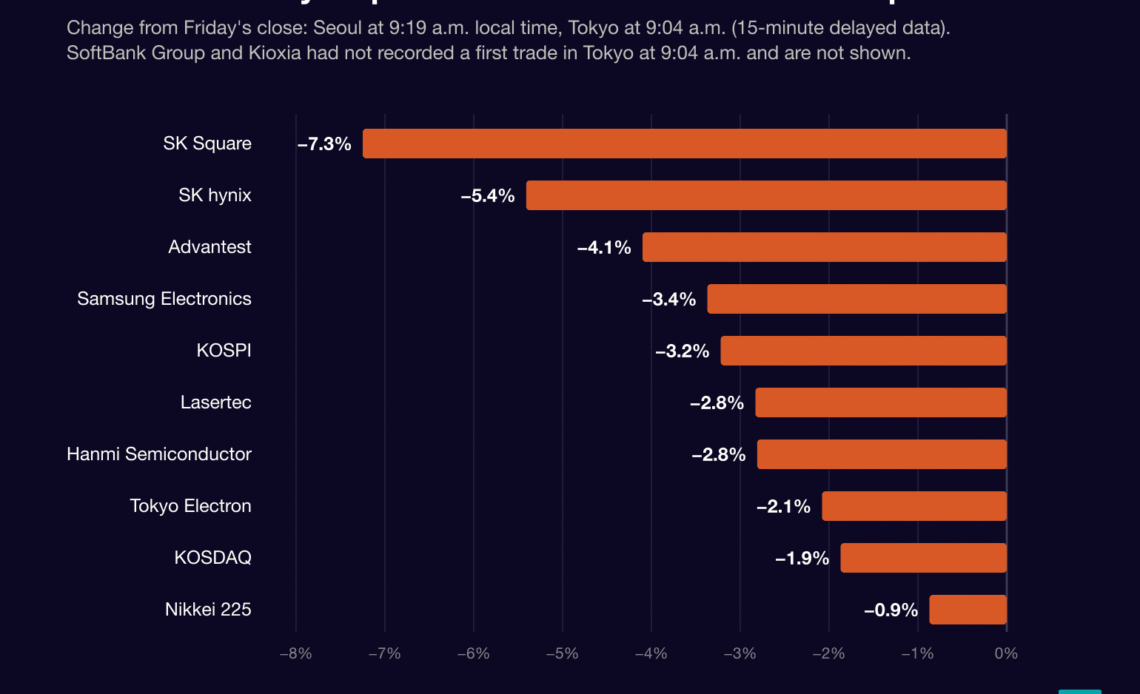
Shares of SK hynix fell 5.4% and Samsung Electronics 3.4% in the first 20 minutes of trading in Seoul on Monday, pulling South Korea’s KOSPI index down 3.2%. It was Asian markets’ first chance to trade a weekend that brought a call from Anthropic’s chief executive to slow AI development, oil above $103 a barrel and a likely U.S. interest rate increase on Wednesday.
Tokyo fell less. The Nikkei 225 was down 0.9% a few minutes after the open, with chip-testing equipment maker Advantest down 4.1% and Tokyo Electron down 2.1%.
Between them, SK hynix and Samsung lost about 123 trillion won, roughly $91 billion, of market value by 9:19 a.m. Seoul time, a TECHi calculation from exchange prices. The gap between Seoul and Tokyo reflects what each market owns. Korea’s stock market is dominated by the two companies that make the memory chips inside AI servers.
Energy Brief
Key Takeaways
5 Points30s Read
- SeoulSK hynix fell 5.4% and Samsung Electronics 3.4% by 9:19 a.m., dragging the KOSPI down 3.2%; together they lost about 123 trillion won, roughly $91 billion, in market value.
- TokyoThe Nikkei 225 fell 0.9% to 1.1% in early trade, with Advantest down about 4% and Tokyo Electron 2.1%; SoftBank Group and Kioxia had not yet traded.
- Why KoreaKorea’s market is dominated by the memory makers that supply AI servers, the part of the chain most exposed to Anthropic CEO Dario Amodei’s call to slow AI, including possible limits on training compute.
- Other shocksOil stayed above $102, Hormuz talks were postponed, and the Fed is expected to raise rates on Wednesday.
- SoftBankSoftBank repays the remaining $25.9 billion of its $40 billion OpenAI bridge loan on Tuesday, Bloomberg reported.
KOSPI falls 3.2% as SK hynix and Samsung lead the losses
Prices at 9:19 a.m. in Seoul (00:19 UTC), compared with Friday’s close, according to real-time exchange data published by Naver Finance:
- KOSPI: down 3.2%, at 6,687.46 from 6,909.91, after opening at 6,692.61
- SK hynix: down 5.4%, at 1,714,000 won from 1,812,000 won
- Samsung Electronics: down 3.4%, at 250,750 won from 259,500 won
- SK Square, the holding company that owns SK hynix’s largest stake: down 7.3%, at 1,010,000 won
- Hanmi Semiconductor, which makes equipment used to assemble high-bandwidth memory: down 2.8%
- KOSDAQ, the smaller-company index: down 1.9%
SK hynix’s market value stood at about 1,252 trillion won after the drop and Samsung’s at about 1,464 trillion won. The morning’s losses equal roughly 72 trillion won for SK hynix and 51 trillion won for Samsung, converted at 1,344.75 won to the dollar.
The selling started before the regular session. On Nextrade, Korea’s alternative exchange, SK hynix was already down 3.15% at 8:15 a.m. and Samsung 2.12%, Seoul Economic Daily reported.

Nikkei 225 down 0.9%: Advantest and Tokyo Electron lower
Tokyo data is published with a 15-minute delay. At 9:04 a.m. Tokyo time:
- Nikkei 225: down 0.9%, at 63,451.49 from 64,011.34
- Advantest: down 4.1%, at 30,420 yen
- Lasertec: down 2.8%, at 33,590 yen
- Tokyo Electron: down 2.1%, at 50,390 yen
- SoftBank Group and memory maker Kioxia: no trades recorded yet at their Friday closes of 6,540 yen and 54,030 yen
Japanese stocks often take several minutes to register a first trade on mornings when buy and sell orders are far apart, so the two untraded names are the ones to watch as data catches up. By 9:07 a.m., the Nikkei had slipped further to a 1.1% loss, and SoftBank, Kioxia and fiber-optic cable maker Fujikura, a supplier to data centers, still had not traded. SoftBank and Kioxia had already fallen sharply on Friday, Kioxia by 7.0% and SoftBank by 4.0%, while Advantest lost 6.5%.
CME Nikkei futures had pointed to a weak start. They were down about 1.8% on Sunday evening in New York.
Monday’s drop reverses Friday’s AI hardware rally
The selling in Seoul undoes much of the optimism that carried AI hardware stocks into the weekend. On Friday in New York, Wall Street rose for the first time in five sessions and the Philadelphia Semiconductor Index gained 1.81%, Seoul Economic Daily noted, helped by expectations of more data-center spending after Oracle’s results.
TECHi’s own stocks page showed the same trade. HPE rose 12.4% and Dell 12.0% on Friday after Oracle said it still plans $90 billion to $95 billion of capital spending this fiscal year. Server makers like HPE and Dell buy the memory that SK hynix and Samsung produce, so a weaker outlook for AI server spending reaches Seoul quickly.
Amodei’s essay was published on Saturday, after U.S. markets had closed. Monday in Asia is therefore the first regular session in which the major chip stocks could trade on it. By the time Wall Street opens, investors will have seen Seoul, Tokyo and Taiwan all react first.
Why memory stocks are most exposed to an AI slowdown
SK hynix and Samsung sell high-bandwidth memory, the stacked memory chips packaged next to AI accelerators such as Nvidia’s. Demand for that memory rises with the amount of computing used to train and run AI models, which is why the two companies’ shares have tracked AI spending so closely. TECHi has covered SK hynix’s race to feed AI demand for that memory.
That is where Anthropic chief executive Dario Amodei’s weekend essay lands hardest. In “We Must Pace the Frontier,” he wrote that “we must slow the pace at which we improve the capabilities of AI models,” and said companies “should also consider pacing based on limiting the ingredients that go into frontier models, such as training compute.” He also wrote that pacing “does not mean halting model training or technical progress.” For a memory supplier, even slower growth in training compute means slower growth in orders.
The essay was not the only cause. Seoul Economic Daily attributed the pre-market weakness to Middle East tension and rising interest rates, and quoted Kiwoom Securities analyst Han Ji-young as citing “the aftershocks of the August CPI, the debate over slowing AI investment and the September FOMC.” In the paper’s translated report, she said investors should use the volatility to add to stock holdings rather than raise cash.
The Korean chip stocks were also under pressure before the weekend. After Monday’s drop, SK hynix was about 43% below its 52-week high of 3,002,000 won and Samsung about 34% below its 380,000-won high, while the KOSPI was about 29% below its 52-week peak of 9,385.59. TECHi examined how SK hynix’s Nasdaq listing collided with a memory bear market in July.
Oil, the Hormuz talks and a Fed rate hike
The other two weekend shocks weigh on Asia’s importers of energy.
U.S. crude futures were up about 2.4% at $102.42 a barrel shortly after the Seoul open, having jumped more than 3% when trading resumed on Sunday evening. Saudi Arabia shut its East-West pipeline around the Strait of Hormuz on Friday after drone attacks, and a vessel was struck in the strait on Sunday. Seoul Economic Daily also reported that a meeting of Iran, Iraq and Gulf states planned for Monday in Salalah, Oman, to discuss safe passage for ships in Hormuz had been postponed. The paper added that concern is growing about Red Sea exports as well, after Yemen’s Houthi rebels seized strategic points around the Bab el-Mandeb Strait at the sea’s southern entrance. Saudi Arabia’s shut pipeline had carried crude to the Red Sea specifically to avoid Hormuz.
On rates, the paper noted that U.S. consumer prices rose 3.4% from a year earlier in August, and that core prices rose 0.3% on the month against expectations of 0.2%. It said CME FedWatch put the chance of a quarter-point Fed hike this week at about 87%. On Kalshi, the prediction market, the contract for a quarter-point hike traded at 77 cents on Sunday evening. The Fed announces its decision at 2 p.m. Eastern on Wednesday.
U.S. stock futures remained lower as Asia opened. Nasdaq 100 futures were down 1.1% and S&P 500 futures 0.5% at 00:10 UTC, extending the pattern TECHi reported when Nasdaq futures fell twice as much as the S&P 500 at the Sunday open.
SoftBank’s $25.9 billion OpenAI loan repayment on Tuesday
SoftBank Group has a specific reason to be in focus this week. The company will repay the remaining $25.9 billion of a $40 billion bridge loan used to finance its investment in OpenAI on September 15, according to a Bloomberg report published by Yahoo Finance. The unsecured loan was not due until March 2027.
SoftBank is refinancing with longer-term debt. It is considering a junk-bond sale of $10 billion to $20 billion, and it has secured a $10 billion margin loan backed by its OpenAI stake, Bloomberg reported. That leaves the value of SoftBank’s OpenAI holding doing double duty, as both a core investment and collateral.
That matters on a day when investors are reassessing AI valuations. OpenAI’s own chief executive, Sam Altman, backed Amodei’s call to “pace the frontier” over the weekend. Separately, the Financial Times reported late Sunday that Anthropic expects a second profitable quarter as its IPO nears.
What to watch in Asian markets on Monday
Taiwan’s open. Taiwan’s market opens at 9 a.m. local time, an hour after Seoul and Tokyo. TSMC makes most of the world’s advanced AI accelerators, and its move will show whether investors are selling AI hardware broadly or mainly memory.
Whether SoftBank and Kioxia open lower. Their first trades will show how heavy the selling in Japan’s most AI-exposed stocks really is.
Foreign flows in Seoul. A continued slide in SK hynix and Samsung through the session would suggest large investors are cutting AI exposure, not just reacting at the open.
U.S. futures before Wall Street opens. Nasdaq 100 futures were still down more than 1% as Asia opened. The cash market opens at 9:30 a.m. Eastern on Monday.