
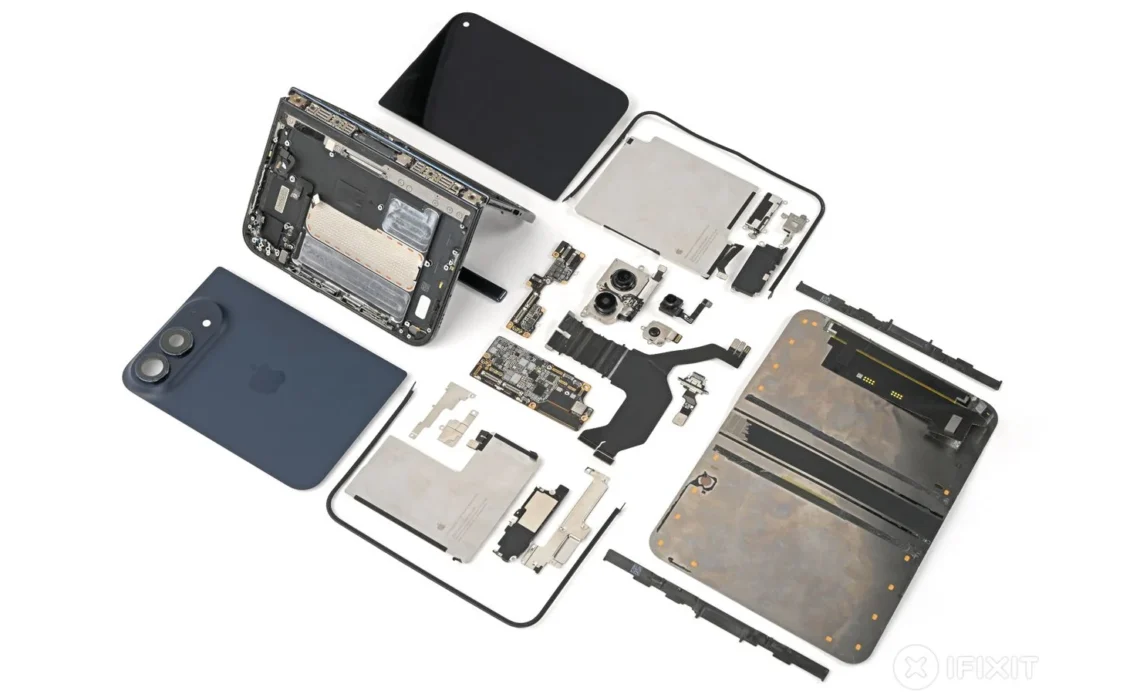
Some iPhone Duo owners have reported screen problems soon after using Apple’s first foldable phone. iFixit has now taken the device apart to investigate what could be behind these failures. The teardown team used CT scans, video footage, and Apple’s patents to create a 3D model of the hinge. Its findings suggest that the central support bar may not retract properly when users close the phone. This could put extra pressure on the display and damage its delicate layers.
The curves of the track the hinge moves along may contribute to this. Several different structures come together at this point and may be putting stress on the display. However, the exact cause of these failures is unknown.
iFixit Examines the iPhone Duo’s Hinge and Dust Protection
Apple has used a complex hinge mechanism in the iPhone Duo to support its folding display. The hinge contains gears, springs, and interconnected metal joints. Its teardrop-shaped design gives the display more room to bend without folding too sharply. Apple also uses curved guides to control the joints’ movement and reduce stress on the screen.
iFixit tested the phone’s dust protection by applying fluorescent powder that glows under ultraviolet light. This allowed the team to track how dust entered the device. The test showed that relatively little dust reached the hinge compared with the Pixel 11 Pro Fold and Samsung Galaxy Z Fold 8. However, the hinge began making crunching sounds after the test. The iPhone Duo has an IP68 rating for dust and water resistance. However, iFixit’s findings suggest that dust can still enter the hinge mechanism. Users should therefore take care when using the foldable phone in dusty environments.
iPhone Duo Gets iFixit’s Highest Repair Score for a Foldable
iFixit has given the iPhone Duo a provisional repairability score of 5 out of 10. This is the highest score the team has awarded to a foldable phone so far. The outer display is relatively easy to remove, while clips allow technicians to remove the inner display’s bezel without breaking it. Apple has fitted two battery cells inside the phone. One sits beneath the back glass, while the other rests beneath the outer display.
The larger battery has a storage capacity of 11.567 Wh, while the smaller one has a storage capacity of 7.506 Wh, for a total storage capacity of 19.073 Wh. iFixit also complimented Apple on its use of electrical release adhesive, which makes it easier for technicians to remove both batteries without forcefully prying them out. To replace both batteries, you must open both sides of the phone. The display and hinges inside the phone are hard to fix due to their complicated design. iFixit’s score is provisional until replacement parts become available.
iFixit also examined the iPhone Duo’s inner display to understand how Apple makes the crease less noticeable. Apple uses a matte nano-texture finish that scatters reflected light across the screen. This makes the crease less visible. In addition, the inspection team found an oval-shaped subpixel oriented in different directions. This can help minimize any visual artifact associated with the crease. In the inside selfie camera, the pixels become bigger, leaving more space between them. This lets more light reach the camera under the screen. The findings show how Apple has worked to improve the foldable’s display design. However, the hinge and inner screen remain challenging components to repair.