
Oracle is cutting staff to pay for the data centers it is building, and its founder has decided not to sell the stock he is asking shareholders to hold. Shares fell about 5% to around $143 on Monday morning after its quarterly filing disclosed that management had added roughly $700 million to a restructuring plan already estimated at up to $2.1 billion, to cover additional actions taken after the quarter closed, in what amounts to a new round of layoffs. That landed two days after Larry Ellison cancelled a trading plan that could have sold 50 million of his shares, about $7.5 billion, without selling a single one.
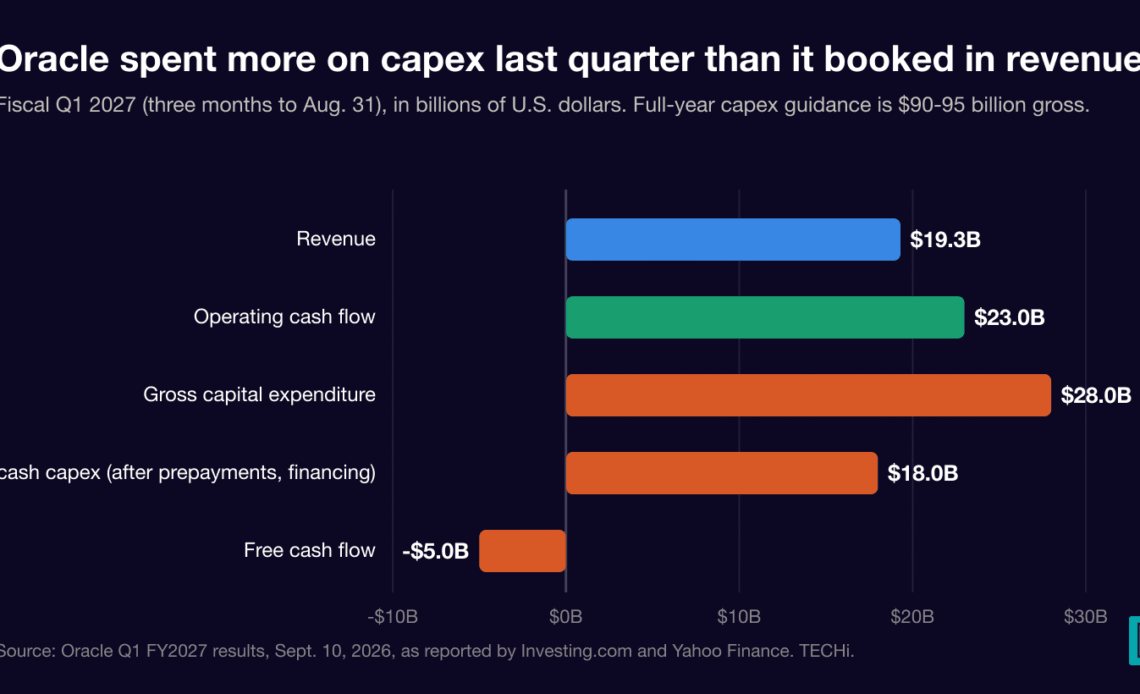
The two headlines are the same story read from opposite ends. Oracle guided to $90 billion to $95 billion of capital spending this fiscal year against $19.3 billion of quarterly revenue, burned $5 billion of free cash in the latest quarter, and sold $20 billion of stock to keep building. A company in that position trims payroll, and its largest shareholder does not add 50 million shares to the float. What the market sold on Monday was not the layoffs. It was the reminder of how far the cash gap runs.
Nebius and CoreWeave, the listed neoclouds that trade as Oracle’s higher-beta cousins, fell about 5% and 6% alongside it.
Article Brief
Key Takeaways
5 Points30s Read
- The cutOracle expanded its restructuring plan by about $700 million, tied to a new round of layoffs, in the 10-Q it filed on Sept. 11, as it spends $90-95 billion on capex this fiscal year.
- The sale that isn’tLarry Ellison cancelled a Rule 10b5-1 plan, adopted June 22, that could have sold up to 50 million Oracle shares (about $7.5 billion) through Oct. 24; none were sold, and the company confirmed it in an 8-K on Monday.
- The tapeOracle fell about 4-5% to around $144 by mid-morning, with Nebius down about 5% and CoreWeave 6% in sympathy, on a day the AI capacity chain sold off.
- The cash mathQ1 FY27 revenue was $19.3 billion against $28 billion of gross capex; operating cash flow was a record $23 billion and free cash flow was negative $5 billion, after a $20 billion at-the-market stock sale in the quarter.
- The readA founder keeping his shares and a company cutting staff are the same signal: Oracle needs every dollar and every share to fund a $664 billion backlog, and the market is pricing how long the funding gap lasts.
Oracle’s restructuring plan: $2.1 billion plus $700 million, and AI is doing some of the cutting
The number came from the fine print. In the 10-Q it filed on Friday, Oracle said the total estimated cost of its fiscal 2026 restructuring plan was “up to $2.1 billion as of August 31, 2026,” and added that “subsequent to August 31, 2026, our management supplemented the 2026 Restructuring Plan by approximately $700 million to reflect additional actions that we expect to take.” It describes the plan as one to “restructure to implement certain strategic measures and further improve operational efficiencies, including through the adoption and integration of artificial intelligence technologies across certain functions and other operational activities,” according to the filing. The addition covers severance and related exit costs, 24/7 Wall St. reported, and the stock was down 5% at $142.88 by 10:19 a.m. ET.
Read the sentence again. Oracle is not only cutting costs to fund AI capacity; it says it is using AI to replace the functions it is cutting. That is the operating model the company is selling to its cloud customers, applied to itself, and roughly $2.8 billion is the price of it.
The severance is small next to the build. Oracle’s own guidance is for $90 billion to $95 billion of gross capital expenditure in fiscal 2027, with net cash capex capped at $70 billion after customer prepayments and financing, according to the results it reported on Sept. 10. Seven hundred million dollars of restructuring is about three days of that spending. Its significance is directional: every operating dollar Oracle can free up is a dollar it does not have to borrow, raise or prepay from a customer.
Ellison’s cancelled 10b5-1 plan: 50 million shares, $7.5 billion, none sold
The second disclosure arrived in an 8-K on Monday morning. Oracle said that Ellison, its executive chair and chief technology officer, “has cancelled his 10b5-1 Plan to sell Oracle stock,” and that “no Oracle stock was sold under that plan, and he has no other plans to sell any of his Oracle stock,” according to the filing, which attached a press release dated Saturday. The plan would have allowed the sale of up to 50 million shares, worth roughly $7.5 billion, and Oracle offered no reason for scrapping it, TechCrunch reported. The plan was adopted in June and would have run into late October, CNBC reported. Oracle shares were down about 22% for the year before Monday’s move.
Fifty million shares is about 1.7% of the company at Monday’s market value of roughly $415 billion, by TECHi’s arithmetic from Nasdaq.com data, so the supply that disappeared is real but not large. The signal is what matters, and it cuts two ways. A founder who set up a sale in June and cancelled it in September, with the stock lower, is a founder who thinks the price is wrong. A company that sold $20 billion of new shares through an at-the-market program in the same quarter has already added far more supply than Ellison withheld. Investors got a vote of confidence from the man and a dilution from the corporation, and on Monday the corporation’s number was the one being traded.
The cash math: $28 billion of capex on $19.3 billion of revenue
The quarter behind these moves was, by the company’s account, the strongest in its history. Revenue rose 30% to $19.3 billion and cloud infrastructure revenue rose 121% to $7.4 billion, non-GAAP earnings per share were $1.92, operating cash flow was a record $23 billion, and remaining performance obligations reached $664 billion, up $209 billion year over year, according to the results. Chief financial officer Hilary Maxson said the one word she would use for the quarter was “acceleration.” Co-chief executive Clay Magouyrk said Oracle had delivered 850 megawatts of AI capacity, including more than 300,000 GPUs, nearly triple the prior quarter.

The same quarter consumed $28 billion of gross capital expenditure, $18 billion net of prepayments and financing, which is why $23 billion of operating cash flow became negative $5 billion of free cash flow, and why the company completed a $20 billion at-the-market equity sale during the period. Maxson did not give a timetable for free cash flow turning positive.
The $10 billion gap between gross and net capex is the part of the model that deserves the most attention. It is capacity that customers have prepaid or that vendors and lenders have financed, which means a share of the data centers Oracle is building are being paid for by the people who will rent them, before they rent them. That lowers the cash Oracle has to find, but it also means the backlog and the balance sheet are intertwined: a customer that slows its own spending slows both. TECHi’s read of that report was that Oracle sold $20 billion of stock to build a $664 billion backlog, reversing years of buybacks, and Monday’s filings are the next two entries in the same ledger.
The bull case is intact on the company’s numbers: AI infrastructure utilization of 97.9%, GPU renewals at an average 20% premium to standard pricing, and roughly half of the backlog expected to convert to revenue within 36 months. The bear case is timing. Capacity that costs $28 billion a quarter to build earns revenue only once it is delivered and billed, and until the two lines cross, Oracle funds the gap with debt, equity and customer prepayments. Layoffs are the smallest of those levers. The stock’s reaction says investors are watching the largest.
Why Oracle fell with the chips
Monday’s tape did not help. The AI capacity chain sold off from the open after the weekend call from Anthropic, OpenAI and xAI to slow frontier development, with Intel, Micron and AMD down 6% or more in premarket trading and the iShares Semiconductor ETF down more than 5% by mid-morning. Oracle is the clearest listed proxy for AI capacity commitments, which is why it trades with the chip names on a day like this and why CoreWeave and Nebius, which rent GPU capacity on the same model with smaller balance sheets, fell 5% to 6%. CoreWeave traded at $84.86 and Nebius at $214.19 in early trading with no company-specific news, per 24/7 Wall St., which is the definition of a read-through: investors sold the business model, not the company. TECHi’s Oracle quote page tracks the stock and its financials against that model in real time.
The slowdown pledge itself may not bind anyone; TECHi argued on Monday that it has no enforcer. But a company that has committed to $90 billion of capex on the assumption that demand keeps compounding is exposed to the mere possibility that its largest customers pace themselves, and Oracle’s largest customers are the labs that made the pledge. The stock was $329.50 at its 52-week high and traded at $144 on Monday, per Nasdaq.com, a decline of about 56% that has already priced a great deal of doubt about the conversion of backlog into cash.
The next three numbers
The restructuring charge will show up in the December quarter’s operating expenses; the question is whether the savings show up in free cash flow. The at-the-market program is the second: Oracle completed $20 billion in the August quarter, and whether it files for more is the clearest read on how the company sees the funding gap. The third is the one Ellison answered for himself on Saturday. He will not sell at $144. The market spent Monday deciding whether it agrees, with the Federal Reserve’s decision on Wednesday and the December quarter’s cash flow statement as the next two chances to change its mind.